The short version
- Pick by jurisdiction first. A venue that will not open an account for your country is not a cheap venue, it is a closed door.
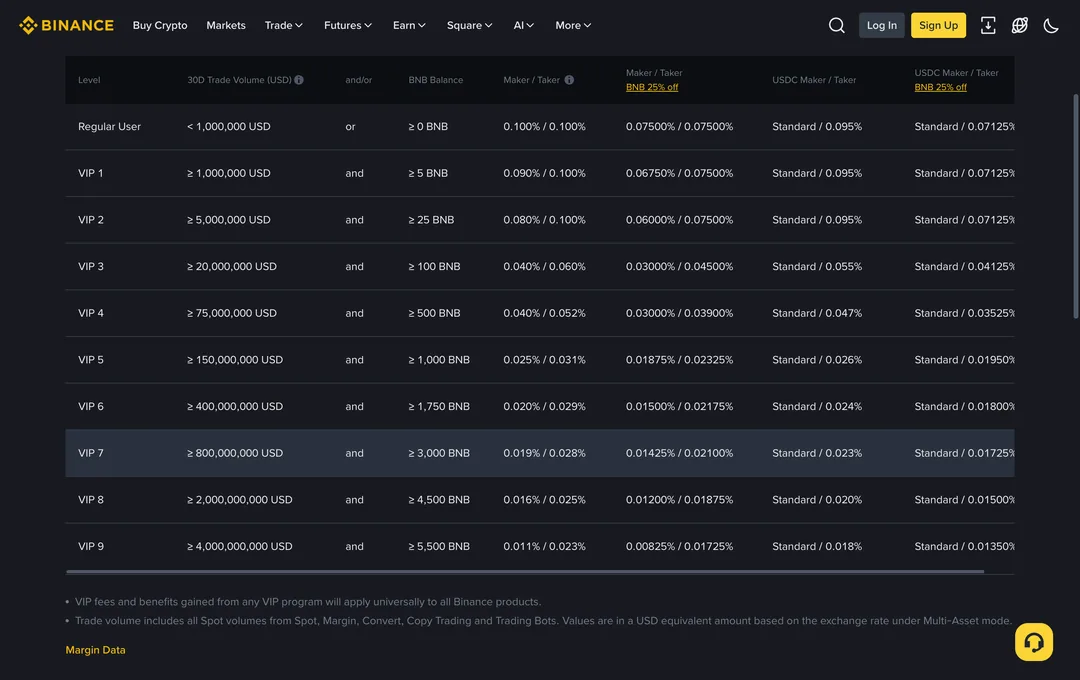
- Outside the US and the EU, Binance is the usual starting point: 0.100% maker and taker on spot for a regular user, 0.075% if fees are paid in BNB.
- In the EU and the UK, Kraken has the clearest paper trail we could verify, and two different fee schedules that people confuse.
- In the US, our referral code is worthless to you, and we say so in that section rather than pretending otherwise.
- Reading in India? The Hindi edition of this guide is written for INR rails and Indian tax rules.
Fees are the second question
The first question is whether the venue will let you in and let you fund the account. Three gates sit in front of every stablecoin purchase: the geographic eligibility check at sign-up, the identity documents the venue accepts from your country, and whether there is a working payment rail from your bank to that venue. A 0.1% fee schedule means nothing if the deposit page has no option for your currency.
Once you have selected Binance.com and confirmed eligibility, the Binance account setup guide shows the public registration screen and the checks to complete before funding.
That is why the sections below are organised by where you are, not by a ranked list. Most English-language comparisons rank venues globally and then bury the availability caveat in a footnote. The caveat is the article.
What the figures here are based on
Fee and licence figures come from each venue’s official fee schedules and legal disclosure pages, read on 2026-08-24; the Gemini stablecoin-pair schedule was read on 2026-09-12. The dated sources are listed at the end. This guide does not quote Coinbase fees or Binance’s prohibited-country list, so check both on the official pages yourself; leaving them out says nothing about whether a product is available to you.
Fee schedules and licence registers change without notice. Treat everything here as a snapshot with a date attached, not a permanent fact.
Outside the US and the EU
Fee schedule read 2026-08-24.
What the fee page does not tell you is whether your country is on the list. Binance keeps a list of prohibited countries on its legal pages; read the current version there rather than relying on a copy in any article. The geographic check inside the sign-up flow is the real authority. Run it before you plan anything around a fee number.
Two more things to settle before you deposit. First, which fiat rails exist for your currency, which varies a lot by country and changes more often than the fee table. Second, which pairs are actually listed for you, because pair availability is set per region rather than globally. Both live on the deposit and markets pages of your own logged-in account, which is the only version of those pages that reflects your jurisdiction.
Inside the EU
Legal disclosures and MiCAR document index read 2026-08-24.
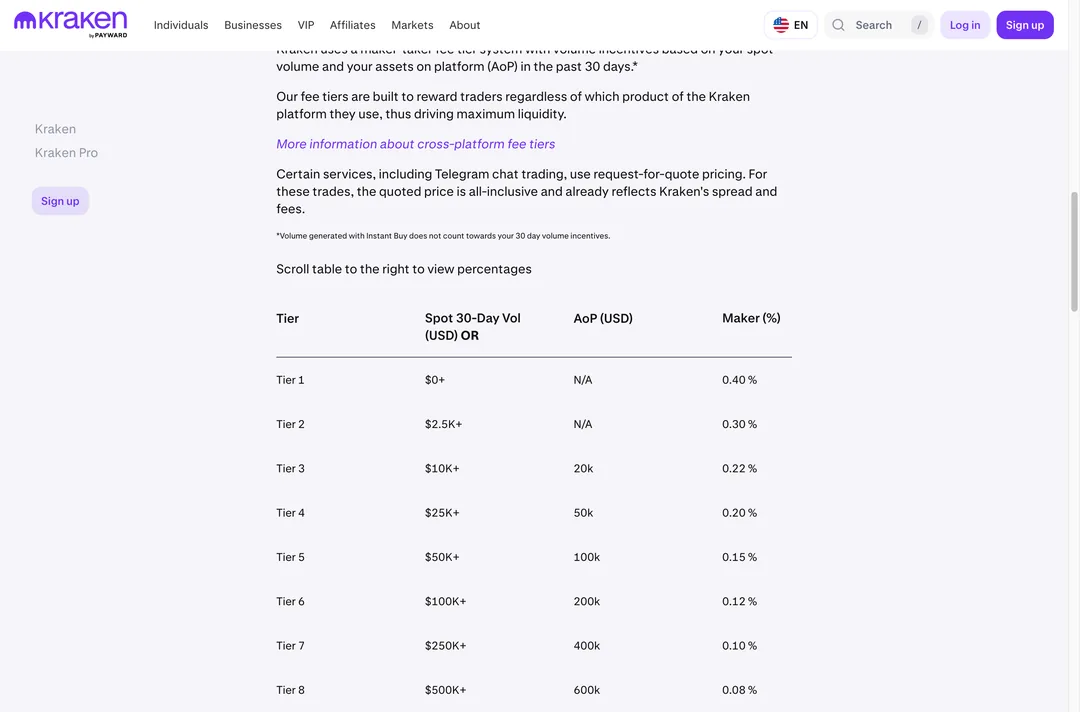
The fee detail that trips people up: Kraken runs two schedules side by side. Standard spot pairs start at 0.40% maker and 0.80% taker for an account with no 30-day volume. Stablecoin, pegged-token and FX pairs start at 0.20% on both sides at that same zero-volume tier. Those are very different numbers for what a beginner thinks of as the same trade, so check which bucket your pair sits in on the fee page before you size the order. A taker order on the wrong schedule costs four times the maker order on the right one.
Euro holders have a second decision to make that dollar holders do not: whether to hold a euro-denominated stablecoin instead of a dollar one and skip the FX exposure entirely. That trade-off has its own piece here — EURC and euro stablecoins under MiCA.
Inside the UK
Same operator, different entity. Kraken discloses that Payward Limited, doing business as Kraken, is registered with the Financial Conduct Authority as a cryptoasset business with effect from 22 November 2021. That registration is an anti-money-laundering registration rather than a broad product authorisation, which is worth knowing before you read too much into it — it says the firm is on the register, not that your trade is covered by a compensation scheme.
Inside the US: this section pays us nothing
Two venues we could verify on paper. Kraken serves US clients through Payward Interactive, Inc., which discloses a FinCEN money services business registration number of 31000270997766, NMLS ID 1843762, and money transmitter licences across all fifty states and the District of Columbia. A second entity, Payward Financial, Inc., holds a Wyoming Special Purpose Depository Institution charter and its own FinCEN registration, number 31000288010248. That is an unusually specific set of registrations to publish, and specificity is the point — you can look each of those numbers up yourself.
Gemini's ActiveTrader schedule separates ordinary spot trading from stablecoin pairs. On September 12, 2026, its stablecoin table listed 0% maker/taker for RLUSD/USD, USDC/GUSD and GUSD/USD, and 0% maker / 0.01% taker for other stablecoin pairs. The ordinary spot entry tier of 0.600% / 1.200% is therefore not a valid blanket estimate for buying USDC. Confirm the product, pair and total order quote, including funding costs.
This guide does not quote Coinbase fees or eligibility terms. If you are weighing Coinbase, go by what its official fee page and user agreement show on the day you buy, and put that number next to the two above.
Reading from India
India has its own rails, its own tax treatment and its own set of available venues, and translating a global guide into Hindi would have produced advice that does not survive contact with an INR deposit. So we wrote a separate one: the Hindi edition.
If the big venues will not accept your country
Sometimes the honest answer is that this guide has no recommendation for you. If the major venues decline your jurisdiction, forcing an account open with a foreign document usually fails at the point where it costs the most — withdrawal, after the money is already inside. Look instead at whichever venues hold a local licence in your country, even if their fees look worse on paper, and read the risk piece on what happens when funds arrive from a counterparty you cannot vouch for: tainted USDT and frozen bank accounts.
What about Bitstamp?
Robinhood announced on 2 June 2025 that it had completed its acquisition of Bitstamp Ltd. This guide does not cover Bitstamp’s current retail offering; if you are considering it, check on Bitstamp’s own site which services it offers in your country before opening an account.
Four questions that settle it
- Where do you live, legally? Not where your VPN says. US, use the US section. EU or UK, use those. Anywhere else, start with the Binance eligibility check and work down from there.
- What currency are you funding with? The rail decides more than the venue does. If your currency has no direct deposit route into your first-choice venue, your effective cost includes an FX conversion nobody put in a fee table.
- How much, this first time? For a small first purchase, put the venue you can actually open ahead of small differences in fee rates, and compare the all-in quote including any card or deposit charge. As the amount grows, the fee schedule and the depth of the pair start to matter more.
- What happens to the coin afterwards? If it sits on the exchange, custody risk is the exchange. If it moves to a wallet, you need the right chain from the start. If it is going to a counterparty, buy the ticker they accept rather than the one with the better story.
Region and size on one line each
| Where you are | First buy size | Where to look first | Check before you fund |
|---|---|---|---|
| Outside US and EU | Under 1,000 USD | Binance | Eligibility check for your country; whether BNB fee payment is worth enabling |
| Outside US and EU | 1,000 to 50,000 USD | Binance, with a second venue opened as backup | Depth on the exact pair; withdrawal limits at your verification level |
| EU / EEA | Any | Kraken | Which fee schedule your pair falls under: 0.20% stablecoin and FX, or 0.40 / 0.80 standard |
| UK | Any | Kraken (Payward Limited, FCA-registered) | What the FCA registration does and does not cover |
| US | Under 1,000 USD | Compare eligible venues and their actual order quotes | Use the stablecoin-pair schedule where applicable; include funding and withdrawal costs |
| US | Above 1,000 USD | Same three, on published fee schedules | Whether the venue publishes its operating entity and licence numbers |
| India | Any | The Hindi edition | INR deposit rail and local tax treatment |
| Restricted market | Any | Locally licensed venues only | Whether you can withdraw before you can deposit |
Three traps that cost beginners real money
The headline fee is not the cost
Total cost is the trading fee plus the spread plus whatever the deposit rail takes. On the same venue, the order book and the one-click buy widget are two different products with two different prices, and the widget is usually the expensive one because its cost hides in the quoted rate rather than in a fee line. Before your first buy, price the same amount both ways in the app and compare the number of coins you end up with. That comparison takes a minute and it is the only fee analysis a first-timer needs.
The same logic applies to any platform advertising zero fees. Zero fee and zero cost are unrelated claims. Ask where the spread is.
The app you downloaded may not be the app
Cloned exchange apps and lookalike domains are a standing problem, and the version that catches careful people is not a crude fake — it is a well-made clone that takes your seed phrase or your login at the moment you are least suspicious, right after a deposit. Two habits that help: reach the store listing by following the link from the venue’s own website rather than by searching the app store, and check the developer name on the listing rather than the icon. If you ever entered credentials into something that turned out to be a clone, treat every account that shares that password as compromised the same hour.
A related failure mode, worth reading before you start trading peer-to-peer, is receiving funds from a counterparty whose money came from somewhere bad — that risk lands on your bank account, not your wallet, and we covered the mechanics in tainted USDT and frozen bank accounts.
A venue whose operator you cannot name
Notice what the verifiable venues in this piece have in common. Kraken names Payward Interactive, Inc. and publishes a FinCEN number you can look up. Gemini names Gemini Trust Company, LLC with an NMLS number. Circle names the entities behind USDC and the fund its reserves sit in. That is the bar. If a platform advertising a rate nobody else can match cannot tell you which legal entity holds your money and under which registration, the rate is not the interesting part of the offer. Run that one test on anything you find through an advertisement.
Frequently asked
Which app is cheapest for buying stablecoins?
There is no single cheapest app. Compare the complete quote for a product and pair you are eligible to use, including funding, spread, trading and withdrawal costs. Kraken and Gemini publish separate stablecoin-pair schedules; applying an ordinary spot entry tier to every stablecoin purchase can overstate the trading fee. A low maker rate also does not apply merely because you entered a limit order: an order that immediately matches can be charged as a taker.
Can I use Binance.com if I live in the United States?
Plan around the separate US platform instead. Binance runs binance.us, which describes itself as a licensed and regulated U.S. crypto exchange. Binance also publishes a list of prohibited countries for binance.com; read the current version on its legal pages. The practical rule is that the geographic check inside the sign-up flow is the authority, not an article. Our referral code is a binance.com code and has no use on the US platform, so nothing in the US section of this guide pays us.
Do I need to pass KYC to buy stablecoins?
On any regulated venue, yes. Kraken names Payward Interactive, Inc. as its US entity, registered with FinCEN as a money services business under number 31000270997766, and Gemini Trust Company, LLC carries NMLS number 1518126. Registrations like those come with identity-verification duties the venue cannot waive for you. If a platform offers to sell you a meaningful amount with no identity check at all, that is information about the platform rather than a feature.
Should my first stablecoin be USDT or USDC?
For a first purchase this matters less than people expect, because the holding period is short and both trade near one dollar. USDC publishes the more legible reserve story: Circle states that USDC is 100% backed by highly liquid cash and cash-equivalent assets and redeemable 1:1 for US dollars, with the majority held in the Circle Reserve Fund, an SEC-registered 2a-7 government money market fund custodied at BNY Mellon and managed by BlackRock, plus monthly attestations by a Big Four accounting firm. For USDT, read Tether's own reserve reports. If you are unsure, buy whichever one your destination venue or counterparty actually accepts.
Is it safer to buy through an exchange or through the buy button in my wallet?
The exchange route is usually cheaper and the wallet button is usually faster. Wallet buy buttons route through third-party card processors that quote an all-in rate, and the spread inside that rate is often wider than an exchange trading fee. The wallet route also skips the exchange account, which some people want and some people regret at withdrawal time. A reasonable split is to use the wallet button for a first small test purchase, then open an exchange account before the amount gets serious.
Sources
Sources below were read on 2026-08-24, except the Gemini ActiveTrader stablecoin schedule, read on 2026-09-12.
- Binance spot fee schedule — regular user 0.100% / 0.100%, BNB 25% off to 0.07500%. binance.com/en/fee/schedule
- Binance list of prohibited countries — check the current list on the page itself. binance.com/en/legal/list-of-prohibited-countries
- Binance.US homepage — self-description as a licensed and regulated U.S. crypto exchange. binance.us
- Kraken fee schedule — entry tier 0.40% / 0.80% standard spot; 0.20% / 0.20% stablecoin, pegged token and FX pairs. kraken.com/features/fee-schedule
- Kraken legal disclosures — Payward Europe Solutions Limited and Payward Global Solutions Limited regulated by the Central Bank of Ireland; Payward Limited FCA-registered as a cryptoasset business with effect from 22 November 2021; Payward Interactive, Inc. FinCEN 31000270997766, NMLS 1843762; Payward Financial, Inc. FinCEN 31000288010248, Wyoming Special Purpose Depository Institution charter. kraken.com/legal/disclosures
- Kraken MiCAR document index — order execution, commercial, risk, conflicts, custody and transfer-services policies. kraken.com/legal/MiCAR
- Gemini ActiveTrader fee schedule — separate spot and stablecoin tables, checked September 12, 2026.
- Circle USDC page — 100% backed by highly liquid cash and cash-equivalent assets, redeemable 1:1, Circle Reserve Fund (SEC-registered 2a-7 government money market fund) custodied at BNY Mellon and managed by BlackRock, monthly attestations. circle.com/usdc
- Robinhood newsroom — completion of the Bitstamp Ltd acquisition, announced 2 June 2025. robinhood.com/newsroom
Keep reading
- How to choose your first stablecoin — which ticker to buy once you have picked the venue.
- What a stablecoin actually is — if this is your first week.
- USDT vs USDC, the 2026 report — the long version of the FAQ answer above.
- Four risks in holding stablecoins — what you are exposed to after the purchase clears.
- How to cash out stablecoins — the exit, which is worth understanding before the entry.
- Glossary — maker, taker, NMLS, MiCAR, attestation.