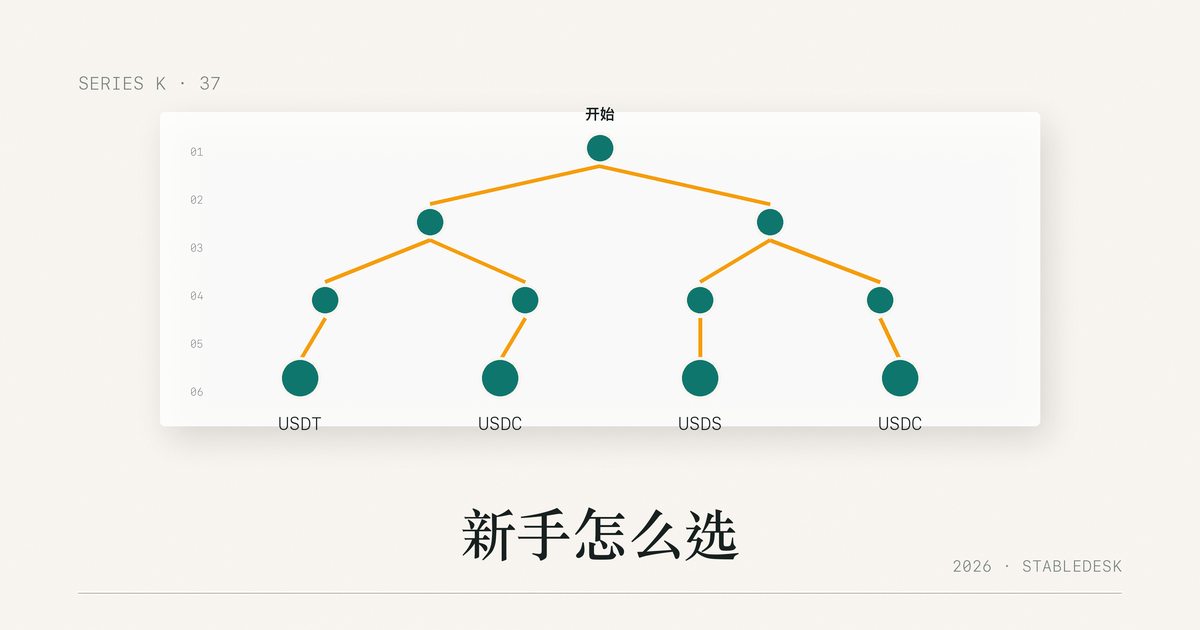
The four criteria, before the answer
Most beginners ask "which is the best stablecoin" and expect a one-word answer. The honest version is that "best" depends on four things you control:
Liquidity at your venue
Regulator and jurisdiction
Reserve quality and transparency
Use-case fit
Six common starting cases · the recommendation for each
You opened a Binance / OKX / Bybit account and want to buy your first dollar token
USDT is worth comparing where your venue offers the pair you need. Check the purchase spread, withdrawal fee and receiving network. A default chain in the app is not evidence that the recipient accepts it, and a token carrying the USDT label may be a bridged representation.
→ Compare USDT with the supported alternatives; choose the network accepted at both ends.
You opened a Coinbase / Kraken / Gemini account in the US
USDC is a useful candidate if your account supports direct USD conversion. Read the quote: conversion fees can depend on account type and volume, and a bank withdrawal or on-chain transfer may add a separate charge. Compare the complete route rather than assuming every USDC transaction is free.
→ USDC, on Ethereum mainnet or Base for withdrawals
You opened an account on a MiCA-compliant exchange (Bitstamp, Kraken EU, etc)
USDT availability on EU-licensed venues has narrowed since MiCA came into force. USDC and EURC are the practical defaults. EURC is the right choice if you receive EUR salary and want to avoid the USD/EUR conversion friction on every transaction. USDC is the right choice if you need USD exposure for crypto purchases.
→ USDC (USD exposure) or EURC (EUR exposure), depending on your salary currency
You want to receive USD from a client in another country
Agree on the token, chain and recipient's cash-out route before sending. For Tron USDT, wallet resource costs differ from an exchange's withdrawal charge. For USDC on Solana or Base, confirm native-token support at the receiving service. Blockchain confirmation and account crediting are separate stages.
→ Use the route both parties can receive and cash out; compare the full quoted cost.
You want to earn yield on a stablecoin in Aave, Compound or similar
Compare the actual lending market: supported asset, available withdrawal liquidity, utilisation, collateral settings and contract risk. Supply and borrow rates change and need not rank the same way across chains. A lower network fee does not make yield predictable or protect principal.
→ Assess the pool and its risks before choosing a supported token.
You want to hold a stablecoin off-exchange for more than three months
A longer holding period calls for a review of issuer exposure, key recovery and whether you need a stablecoin at all. Using more than one issuer can reduce an issuer-specific loss, but banks, the dollar and custody providers may be shared. A calendar threshold does not justify a fixed allocation.
→ Decide the total exposure and custody plan first; no universal USDT/USDC split follows.
The shortlist · what we actually consider for a first stablecoin
USDT (Tether)
Consider USDT when the pair and transfer route you need support it. Read Tether's dated reserve assurance and redemption terms, including eligibility and fees. Tether's fiat-token issuer is based in El Salvador. Past recoveries do not prove that every redemption request has been or will be honoured.
USDC (Circle)
Consider USDC when your bank-conversion route, exchange or protocol supports it. Circle publishes reserve disclosures and its listed parent files audited annual financial statements. The SVB episode shows that a narrow reserve mix can still face banking-access risk. Identify the Circle entity and terms applicable to your location.
FDUSD (First Digital)
Consider FDUSD for a supported pair after checking the current trading fee and exit route. First Digital Labs is the brand of FD121 (BVI) Limited; First Digital Trust's Hong Kong custody role is separate. Neither a custodian's location nor an old Binance promotion establishes HKMA licensing or free trading today.
DAI / USDS (Sky)
Consider DAI or USDS if a specific Sky or DeFi route calls for it. They are distinct tokens connected by the protocol's conversion mechanism. Collateral, governance and real-world asset arrangements add dependencies; visible on-chain balances do not fully reveal off-chain custody or legal enforceability.
EURC (Circle)
Consider EURC when the obligation or amount you want to preserve is in euros. Circle France's EEA terms identify it as an ACPR-authorised electronic money institution. Do not describe EURC as simply sharing USDC's US state regime. Compare the EUR exit route and remember that EURC still changes value against dollars.
PYUSD (PayPal / Paxos)
Consider PYUSD if your PayPal account or intended recipient supports it. Paxos Trust Company, N.A. is the issuer under OCC supervision following its December 12, 2025 conversion. Check country eligibility, network support and the complete payout cost; PayPal access alone does not establish PYUSD availability.
Three things to avoid as a beginner
1 · Stablecoins without a recent reserve disclosure
If the issuer has not published a reserve report in the last quarter, the stablecoin is not actively maintained at the standard a working desk would want. The disclosure cadence for USDT (quarterly) and USDC (monthly) is the floor; below that, you cannot price the risk.
2 · Algorithmic stablecoins
A design that relies on a volatile companion token needs a different risk assessment from cash-backed issuance. The GENIUS Act was signed on July 18, 2025; it is no longer a proposal. Legal treatment depends on the product and applicable rules. The mechanism risk is explained in our Luna postmortem.
3 · Small-cap stablecoins
Check depth and exit access directly. Market capitalisation alone does not reveal the team, reserves or liquidity available for your order. A token can have a large reported supply and still trade poorly on your chosen venue.
The first-thirty-days plan
The desk's working recommendation for someone holding zero stablecoins today, in roughly this order:
- Check a provider's eligibility. Confirm that it serves your jurisdiction and supports the token, chain and bank route you need. Complete required verification before depositing.
- Choose a test amount you can afford to lose. It must exceed the receiving service's minimum after fees; a fixed amount does not work for every route.
- Prepare a wallet you control. Verify network and token support, secure its recovery material and retain the native asset needed for a later send. Then check the withdrawal preview.
- Send back to the exchange. Round-trip the test. Confirms the wallet works, the chain selection is right and the deposit-credit timing on your venue is what you expect.
- Then decide on size. After the round-trip, you have done the operational learning. Now the question of "how much" is much easier to answer.
Mistakes the desk sees most often
Picking the wrong chain
USDT on Tron and Ethereum uses different networks and address formats. A wallet may reject an incompatible address, while a deposit sent on an unsupported network may remain uncredited. Recovery depends on key control and the receiving service; neither automatic recovery nor certain permanent loss should be assumed. Match the token contract and network before sending.
Confusing USDT and USDC at signup
The two tickers differ by one letter. Several exchanges have similar buy-flow buttons for both. The risk is buying USDT when you meant USDC or vice versa. The fix is operationally trivial (swap them on the spot pair) but produces an unnecessary fee. Read the ticker before confirming the order.
Treating stablecoin balance as a savings account
USDT and USDC do not earn interest merely by sitting in a wallet. Lending, rewards and tokenised investment products have separate terms, eligibility and loss risks. Compare those products on their own merits; a stablecoin's dollar target does not make a lending balance an insured savings account.
The one-sentence answer for everyone else
Choose a token only after checking the provider's local eligibility, the recipient's network and your route back to money you can spend. Then test that route with an affordable amount before increasing exposure.
Further reading on this site
- USDT vs USDC, the 2026 report — the six-dimension cornerstone, if you want the long form on the two-token choice.
- What is a stablecoin, in ten minutes — the primer covering the four families and how the peg works.
- The four stablecoin types compared — fiat-backed, crypto-collateralised, algorithmic, commodity-backed; deeper than the primer.
- Is a stablecoin safe? Four risks worth pricing — depeg, regulator, smart-contract and counterparty risk explained.
- Glossary — definitions for every term used in the articles.