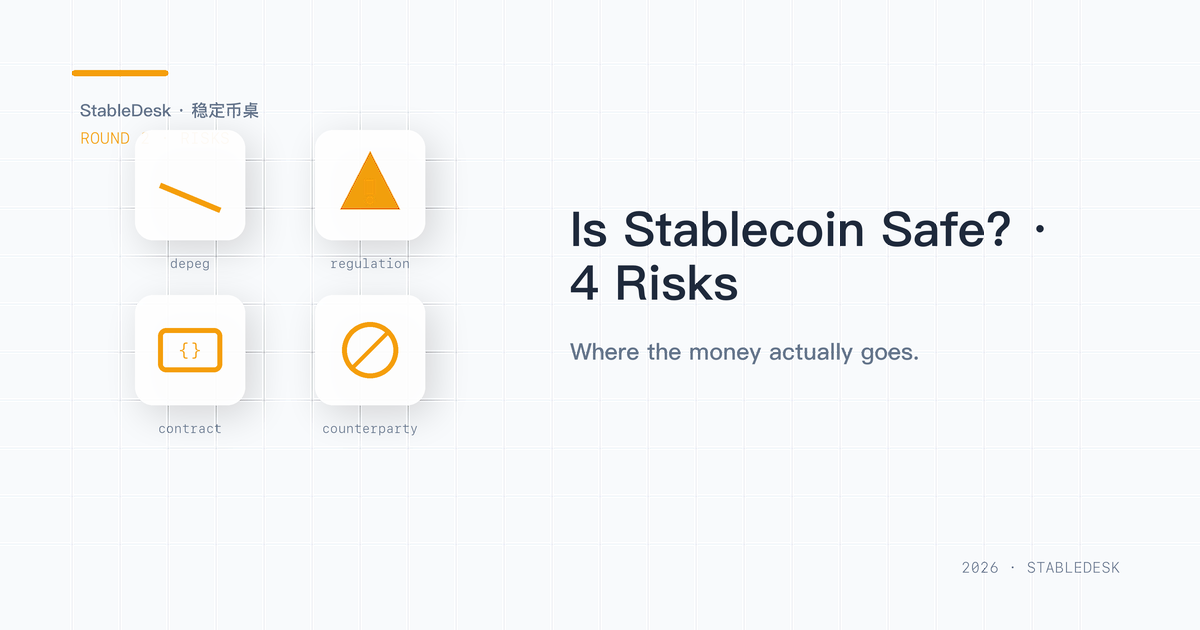
The frame · safe against what
"Safe" is a relative term. A stablecoin is safer than holding a volatile crypto asset like Bitcoin for the use case of holding a stable dollar value over a short period. It is less safe than a US Treasury bill held directly through a brokerage account because there are intermediate layers that can fail. The four risks below are the layers that can fail; understanding them lets you size your stablecoin position relative to your real alternatives.
Risk 01 · Depeg
The token trades below one dollar
What history shows. USDC's March 2023 banking shock and UST's 2022 collapse had different causes and outcomes. DAI was also exposed to the USDC disruption through its collateral. Selected recoveries cannot establish a probability of recovery or a maximum loss. See the sourced USDT cases for the distinction between a token, a trading pair and a venue.
What can put a peg under pressure. Reserve-bank failure, restricted redemption, a run on an endogenous-collateral design or stress transmitted through another token's collateral. These mechanisms do not by themselves establish comparable event probabilities across categories.
What a market drop does not prove. A fall in bitcoin does not, by itself, establish a shortfall in a stablecoin issuer's reserves. Conversely, price stability on one venue does not prove that holders elsewhere can withdraw or redeem.
Risk 02 · Regulator-driven seizure or freeze
The issuer freezes your address
What has happened historically. Both issuers have used address-restriction powers. A count requires a dated, chain-specific dataset and a definition that distinguishes blocked addresses, later unfreezes and affected tokens. A raw count does not measure an individual holder's risk.
What it means for an ordinary holder. An investigation, legal order or erroneous restriction can affect access. Keep records of where funds came from and use the provider's documented support process if tokens are blocked. Avoiding a known sanctioned address does not prove that freeze risk is zero.
The harder case. A regulator-forced delisting of an entire stablecoin — BUSD in 2023, USDT on EU venues since 2024 — is not a freeze of individual addresses, but produces similar economic effects on holders who cannot easily exit on their preferred venue. The mitigation here is venue diversification, not just token diversification.
Risk 03 · Smart-contract failure
The token contract or a wrapper protocol has a bug
What has happened historically. The USDT and USDC contracts on Ethereum mainnet have been deployed since 2018 (USDC) and 2017 (USDT, after migration from Omni) without a critical bug exploited at the token contract level. Both contracts have been audited multiple times. The same applies on most major chains where the tokens are deployed.
Bridge failures. Major incidents include Wormhole in February 2022, Ronin in March 2022 and Nomad in August 2022. A bridge failure can leave a token on the destination chain without access to the assets intended to support it. Loss and recovery figures need to be read incident by incident; an amount initially taken is not necessarily the final net loss to holders.
DeFi protocol failures. Several DeFi protocols holding stablecoin deposits have failed for smart-contract reasons. Iron Bank had a freeze in late 2022. Euler was exploited for about 200 million in March 2023 (most recovered). Various smaller protocols have had episodic incidents. The recoverability depends on the specific incident and the protocol's design.
Risk 04 · Counterparty collapse
The exchange or lender holding your stablecoins fails
What has happened historically. The major exchange and lender collapses since 2014 cumulatively cost retail users billions. The biggest individual events:
- FTX (November 2022). Stablecoin balances were caught in the exchange failure alongside other assets. FTX's July 17, 2026 distribution announcement scheduled a fifth round for July 31: cumulative distributions of 105% for allowed Class 5A and 5B customer claims and 120% for Class 7 convenience claims. These are percentages of allowed dollar claims under the plan, subject to eligibility and distribution requirements; they do not mean every customer has received payment or had the original quantity of cryptocurrency returned.
- Celsius (June 2022, bankruptcy July 2022). Roughly 4.7 billion in customer assets. Stablecoin depositors were affected alongside other token holders. Restructuring plan distributions began in early 2024.
- Voyager (July 2022). Roughly 1.3 billion in customer assets. Recovery has been partial through bankruptcy proceedings.
- Genesis Capital (January 2023). Roughly 3 billion in customer assets including stablecoin lending positions. Partial recoveries ongoing.
- BlockFi (November 2022, after FTX exposure). Roughly 1.3 billion in customer assets. Substantial recovery achieved through 2024.
- QuadrigaCX (2019). Canadian exchange that lost roughly 190 million. The smaller scale obscures that the loss rate to customers was effectively total.
- Mt Gox (2014). The original exchange collapse. Roughly 850,000 BTC lost. Bankruptcy distributions to creditors began in 2024 — ten years later.
What this means in practice. Centralised custody adds a failure mode independent of the token's peg. This list of incidents does not establish which risk is most likely for a particular holder. Exposure depends on where and how the tokens are used.
The aggregate picture
The four risks overlap, so incident totals should not be presented as a probability ranking:
- Counterparty collapse. Separate temporarily inaccessible assets, insolvency claims and final recoveries.
- Smart-contract failure. Distinguish the token contract from a bridge, wrapper or lending protocol.
- Depeg events. Separate a market quote, a realised sale loss and a permanent reserve shortfall.
- Regulator-driven freeze. Restricted access can be serious even without a market-wide price change.
Start with the risks you actually take. An exchange user must assess custody; a bridge user must assess the bridge; a self-custody holder still depends on keys, issuer powers and redemption. The appropriate priority follows from those exposures.
What a working risk policy looks like
- Working balance on an exchange: relate it to the intended transactions and the consequences of losing access. A universal dollar cap is not justified.
- Alternative venue: verify eligibility and an exit route before it is needed; another account does not require a fixed funded balance.
- Self-custody balance: assess key security, backup recovery and issuer concentration. The number of devices should follow the recovery plan, not an arbitrary dollar threshold.
- DeFi position: only what you can afford to lose to a smart-contract incident. Stick to protocols with multi-year track records and substantial total value locked.
- Long-term cold storage: review recovery material using the wallet maker's safe backup-check procedure. A successful send confirms access to the current wallet, but does not prove that a separately stored seed backup can restore it.
The risks the desk does not lose sleep over
To balance the list above, three risks the desk thinks are overweighted in retail conversation:
- "USDT will collapse because Tether is unaudited." An assurance report's limits deserve attention, but they do not prove imminent collapse. Equally, past stress events cannot establish that every conceivable stress has been survived or every redemption fulfilled.
- "USDC is a CBDC by another name." Circle is a regulated US fintech with public reporting. That is closer to a traditional banking-relationship product than to a CBDC. Real CBDCs (digital RMB, e-CNY) operate on different rails and have different surveillance properties. Conflating them obscures the actual risks of each.
- "All stablecoins will be banned." Rules depend on the jurisdiction, issuer and activity. The GENIUS Act was signed on July 18, 2025, while MiCA has its own authorisation and offering requirements. Neither a global-ban prediction nor a blanket permission claim helps establish the route available to you.
Further reading on this site
- USDC and the SVB weekend: reserves, access and recovery — the depeg case study in detail.
- Why algorithmic stablecoins fail — the Luna postmortem.
- Is USDC safer than USDT — the issuer-comparison version of the safety question.
- USDT vs USDC, the 2026 report — six dimensions including failure history.