The short version, before the detail
SVB failed on March 10, 2023. Circle disclosed $3.3 billion of USDC reserves at the bank. On March 12, the Treasury, Fed and FDIC announced protection for SVB depositors, with access to funds from March 13. Circle's subsequent update said the affected reserve deposit would be available when banks reopened.
That sequence explains the banking-access problem. It does not establish one universal market low: exchange trades, DEX quotes and a provider's conversion service are different observations. The timeline keeps those distinctions visible.
Background · why SVB held Circle reserves
Circle identified the money at SVB as a USDC reserve deposit. It should not be described as reserves mixed into ordinary corporate operating accounts without evidence. The relevant risk was access to a reserve-bank claim after that bank failed.
Circle's March 2023 update already pointed readers to CUSIP-level Treasury holdings through the Circle Reserve Fund. Those fund holdings and bank cash are different reserve components; transparency about Treasury securities does not establish immediate access to a failed bank deposit.
The timeline
SVB faces liquidity pressure. A bank can hold assets yet struggle to meet withdrawals on demand; that distinction is central to what later happens to Circle's reserve access.
SVB is closed and the FDIC becomes receiver. Access to uninsured deposits is uncertain before the later systemic-risk decision. A reserve claim on the bank is not cash immediately available for a token redemption.
Circle identifies $3.3 billion of reserve exposure at SVB. Its public updates distinguish the affected deposit from the other reserve assets. The disclosure makes the banking dependency concrete without establishing the price at every trading venue.
USDC trades below its dollar target while banking access is constrained. A pool can accumulate the token that sellers want to exit, making another sale more expensive. Price impact and redemption access are separate from the nominal value of reserves.
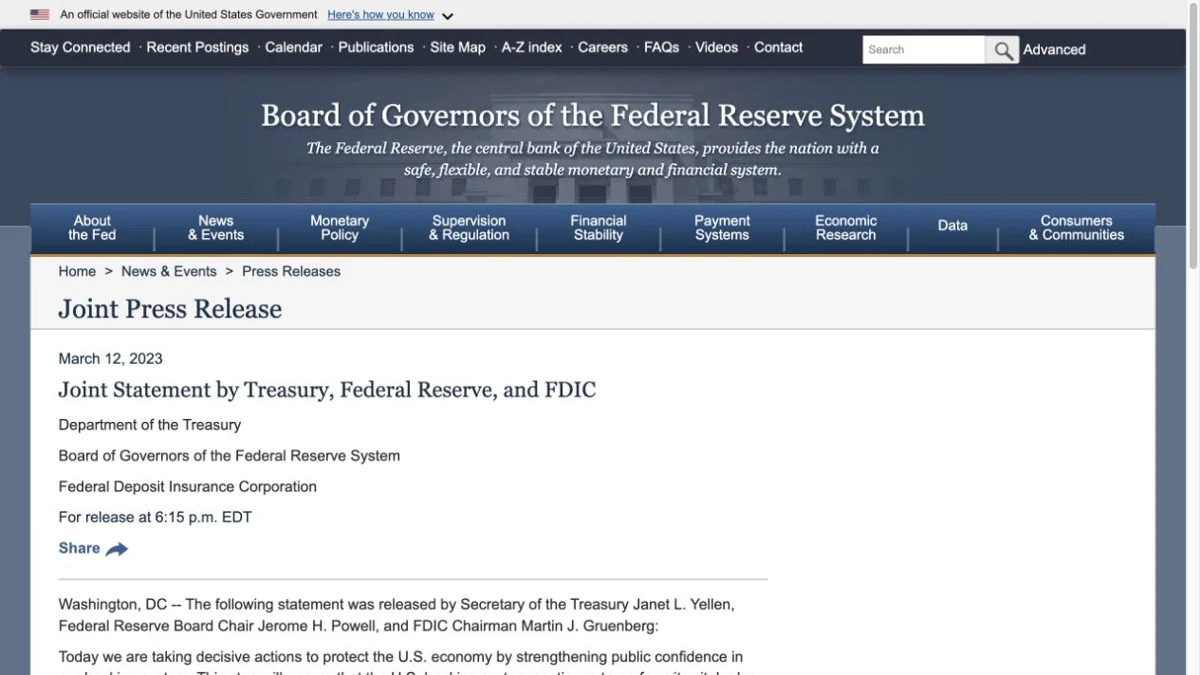
The Treasury, Fed and FDIC announce protection for SVB depositors under a systemic risk exception. The statement gives March 13 as the date of access to their money. The Fed separately establishes BTFP lending for eligible institutions; that is not the depositor-payout mechanism.
Circle's update says the SVB reserve deposit will be available when banks open and describes new banking arrangements. The recovery in access helps restore the redemption mechanism, but does not set one exact recovery time for every market quote.
What happened to USDT during the same weekend
A USDC/USDT quote measures one token against another. It cannot, by itself, establish either token's dollar price: a widening cross-rate can reflect USDC weakness, USDT strength or both. A dollar-premium claim needs an independent dollar quote from the same time.
Different issuer exposures can produce different behaviour in a crisis. That is a reason to examine concentration, not evidence that the two tokens are reliable hedges for each other. Shared banks, venues and dollar-market conditions can still connect their risks.
The arbitrage windows that opened
The episode illustrates two possible trading mechanisms, without establishing that a particular trade was executable or profitable:
- Cross-venue USDC. A price gap creates an opportunity only if both trades, withdrawals and settlement can complete after fees. A displayed price and a paused conversion service do not establish an executable route.
- DAI contagion. Exposure to USDC through Maker's collateral and peg-stability arrangements transmitted stress to DAI. Buying the discount meant taking the risk that the underlying problem would persist; it was not a guaranteed arbitrage.
A retrospective account must distinguish a trading idea from an evidenced fill. Without order records, transaction receipts and the relevant market data, this article cannot claim a realised return or identify which investors completed those trades.
What the desk learned
Lesson 1 · Reserve disclosure transparency matters in real time
Circle disclosed the 3.3 billion SVB exposure on Friday evening. That disclosure was the catalyst for the deeper Saturday morning trough but also the reason the market could price the worst case. If the disclosure had been delayed (until Monday, say), the depeg might have been shallower in the first 12 hours but more severe over the weekend as uncertainty compounded. The desk's read is that the Friday-evening disclosure, while painful, was the correct call.
Lesson 2 · The resolution depended on a political choice
The BTFP and the depositor backstop were discretionary. The Treasury, Fed and FDIC chose to invoke the systemic-risk exception. That choice was made in roughly 36 hours, under pressure, with limited precedent. A different bank failure, with a different depositor profile and different political context, could produce a different choice. USDC's recovery is not a structural feature of its design; it was an outcome of a specific policy decision.
Lesson 3 · Operational pauses read as solvency signals
Coinbase's USDC-USD pause was procedural. Circle's redemption pause was procedural. Both were technically necessary because US banking rails were closed. Both were read by the market as solvency signals and contributed to the deeper Saturday trough. The lesson for issuers: communications around operational pauses need to be more aggressive about the technical reason. The lesson for holders: a procedural pause and a solvency pause look identical from the outside; you cannot tell them apart in real time.
Lesson 4 · Stablecoin diversification is not a slogan
A second issuer can reduce an issuer-specific exposure, but it does not establish a flat portfolio return during a crisis. The outcome depends on allocation, custody, execution and whether either exit route remains open. This reconstruction is not evidence of a desk portfolio's performance.
What changed afterwards
Circle described changes to banking arrangements in its March update. The BlackRock fund's CUSIP-level holdings were already publicly referenced then; they should not be presented as a disclosure introduced only after the crisis. Compare dated reserve reports to assess later allocation changes.
Circle's June 2025 IPO added public-company reporting obligations. Corporate financial statements and reserve attestations have different scopes; neither demonstrates that every holder can redeem immediately during a banking disruption.
BTFP was a separate bank-liquidity programme, not an extension of deposit insurance to USDC holders. The event-specific SVB protection does not create a standing promise that future reserve-bank failures will receive the same treatment.
Could a USDC depeg this size happen again?
A narrower reserve mix and clearer disclosures help readers assess exposure. They do not prove that government instruments, repos, custodians or bank access cannot be disrupted. The current counterparty mix must be established from current disclosures.
Different causes are not zero. A failure of a custodian bank holding the cash residue, a disruption to the overnight repo market, a US regulator action against Circle directly, or a software vulnerability in the contract layer would each produce a different depeg vector. The desk's working assumption is that the next USDC stress event will look nothing like the SVB weekend, and that holders who pattern-match too literally on the 2023 reconstruction may miss the actual signal when it comes.
Three reflections that aged well
The "stablecoin = T-bill ETF" framing is too clean
USDC is neither a Treasury ETF share nor an insured bank deposit. Its reserve can contain fund interests and bank deposits, but a token holder has the rights set out in the token terms. Reserve assets and the holder's legal claim must be examined separately.
The "fully reserved" disclosure language matters less than the reserve mix
Circle described USDC as fully reserved and identified the affected SVB deposit. That issuer statement should not be converted into this article's independent guarantee of every balance throughout the weekend. The distinction remains useful: reported backing and immediate access to redemption resources are different claims.
The peg recovery looked V-shaped because the policy response was fast
The 48-hour recovery is often cited as evidence that USDC's design is resilient. The desk reads it as evidence that the US policy response was fast. The two are not the same. A slower policy response would have produced a longer, shallower, more damaging recovery curve. The peg's resilience is partly structural and partly path-dependent.
Documents behind the SVB reconstruction
- Circle, "An Update on USDC" (March 10, 2023 evening); subsequent updates March 11-13 on circle.com/blog.
- Circle's March 2023 reserve and banking updates; no archived exchange ticker is supplied with this article.
- Market-mechanism explanations distinguish DEX quotes from executed trades and bank conversion.
- FDIC press releases, March 10-12 2023, "Joint Statement by Treasury, Federal Reserve, and FDIC".
- Maker Protocol forum posts and emergency governance polls, March 11-13 2023.
- Circle Internet Group's 2025 Form 10-K on SEC EDGAR — later corporate reporting, separate from the weekend statements.
The reconstruction follows the public statements above. If you spot an error, the corrections log is on the corrections page — write to [email protected] with the line and a source.