Before comparing depegs, compare the quotes
USDT/USD is a price in dollars. USDC/USDT is a price in another token. A chart can show a sharp move in the second pair while USDT stays close to a dollar. Even two dollar charts can differ: the lowest completed trade, the best available bid and a market-wide average answer different questions.
For a historical low to be useful, it needs a venue, a pair, a timestamp and a definition of the measurement. A single trade through a thin order book is not the price at which every holder could sell. Nor does the first trade back at $1 establish that withdrawals, banking access and market depth have recovered.
The episodes below are selected historical contexts, not an exhaustive price dataset or a ranking by severity. They use regulator findings, contemporary issuer statements and market research. March 2020 and June 2022 remain as context; the sources here do not establish a comparable USDT trough or recovery duration for either period.
2018: the reserve problem cannot be waved away
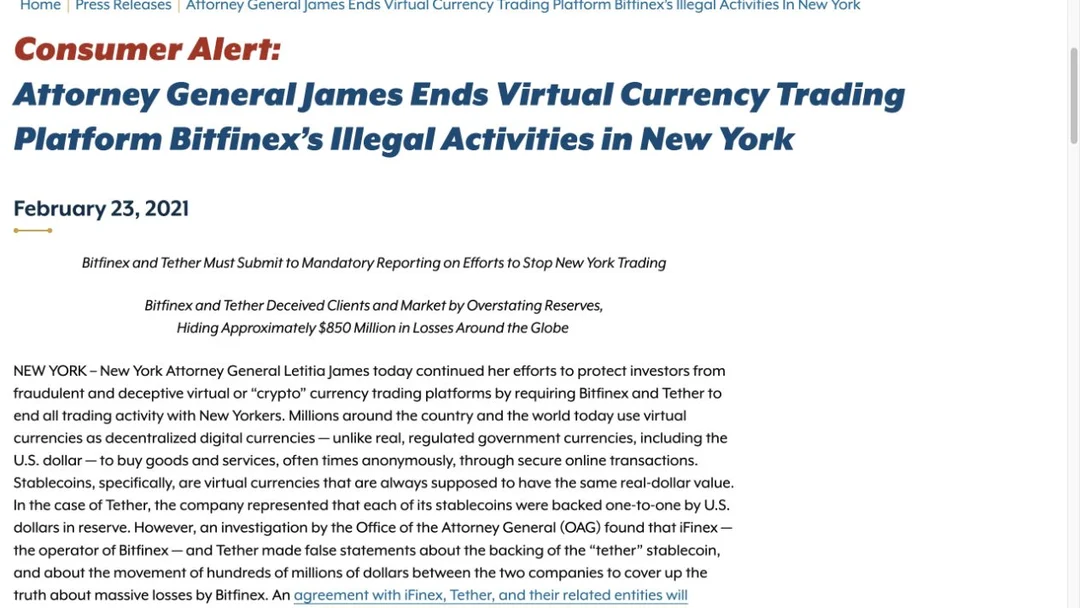
The later investigation matters when reading the earlier panic. In February 2021, the New York Attorney General reported that Bitfinex had lost access to roughly $850 million held through Crypto Capital and that the companies had misrepresented the movement and backing of funds. The findings included periods without the promised dollar reserves and transfers from Tether to Bitfinex in November 2018.
That is incompatible with describing the entire episode as unfounded fear. It also does not prove what caused every trade on October 15: the November transfers and the October price move are different events. The NYAG announcement is evidence about backing and disclosure, not an exchange price series. This revision removes the earlier article's unsupported Kraken low and three-week recovery claim.
A distinction worth keeping: money that cannot be accessed promptly and money that is missing are different problems, but both can weaken a redemption promise. Calling a problem “liquidity” does not establish that all the assets are there. Calling it “insolvency” requires evidence too.
2020 and 2022: shared stress, different mechanisms
March 2020: do not borrow DAI's crisis as a USDT price record
Maker's own Black Thursday compensation proposal describes collateral-price falls, expensive Ethereum transactions and failed liquidation auctions, including collateral sold for zero DAI. Those are protocol and auction failures. They do not establish the USDT low or the DAI dollar quote asserted in the previous version of this article.
Several assets can come under pressure on the same day without having the same failure mechanism. A collateral auction, a token holder selling on an exchange and an issuer sending dollars to a verified customer are separate transactions. A convincing account of contagion has to connect them rather than simply putting their charts beside one another.
May 2022: what Tether said it was redeeming
During the Terra collapse, Tether's May 12 announcement said it had processed more than $300 million of redemptions in the preceding day and was processing more than $2 billion that day. It specified verified customers in permitted jurisdictions. These are contemporary issuer statements; they are not independently checked bank settlement records.
The distinction between those customers and an ordinary exchange seller is central. A holder looking at a discounted bid cannot assume they have the same redemption access, fees or settlement timing as an approved customer. The existence of that route can help close a price gap without making it equally accessible to everyone. The Terra failure is a separate case study; it should not be used to imply that USDT and UST had identical backing.
June 2022: examine the exposure, not just the association
The relevant follow-up is Tether's July 8 Celsius disclosure. Tether said its loan was overcollateralised with bitcoin and had been liquidated without loss to Tether. That narrows the issuer's account of a particular exposure. It does not independently verify the rest of the reserve portfolio or tell us how long a USDT discount lasted in June.
March 2023: a USDC discount is not automatically a USDT dollar premium
Circle's SVB update identified $3.3 billion of reserves at the failed bank and said those funds would be available following the US authorities' deposit backstop. That was a concrete bank-access problem behind the USDC weekend crisis.
It is tempting to look at USDC selling for less than one USDT and conclude that USDT must be worth more than a dollar. That conclusion skips a conversion. You also need a dollar price for USDC at the same time.
Arithmetic example, not a reconstructed trade: suppose one USDC costs $0.90 and buys 0.90 USDT. Dividing $0.90 by 0.90 gives $1 per USDT. The cross-rate has moved away from one even though USDT is exactly at its dollar peg in this example.
A claimed dollar premium therefore needs a dollar quote or a properly calculated cross-rate using matching timestamps. It cannot be inferred from USDC/USDT alone. The older version's premium range was not supported by its own calculation and has been removed.
June 2023: the discount extended beyond one Curve pool
Kaiko's June 19 market review reported USDT trading around $0.995 on both centralised and decentralised exchanges. It examined selling on several markets alongside the imbalance in Curve's 3pool. Its Monday snapshot still showed USDT accounting for 48.5% of that pool.
Those observations contradict the earlier article's claim that this was confined to one pool and resolved within six hours. They are still observations from particular markets and times, not a universal minimum price. The review is useful precisely because it looks beyond the pool that attracted the headlines.
Pool composition tells you what liquidity providers are left holding. A large USDT share can accompany people selling USDT for the pool's other assets. It does not, by itself, tell you why they are selling or prove a reserve deficit. Order flow is evidence of pressure; assigning a motive takes additional evidence.
What each kind of evidence can answer
| Evidence | Useful for | Does not establish |
|---|---|---|
| Exchange quote or trade | The price on that pair at that time | Issuer solvency, or the execution price for a larger order |
| Pool balances | Liquidity composition and changes in inventory | The reason for selling or the state of off-chain reserves |
| Issuer redemption statement | What the issuer says it processed and for whom | Independent confirmation of every payment or access for every holder |
| Regulatory finding | The conduct and period examined | Today's reserve balance or the next market price |
The Federal Reserve staff study Primary and Secondary Markets for Stablecoins explains how issuance and redemption interact with exchange trading. The distinction helps explain why a market price can depart from an issuer's redemption terms. It does not make a discount imaginary: a holder who must sell at that bid receives less.
Mint and burn records add another piece, but a token burn is not a bank receipt. A reserve report also has a reporting date and a defined scope. Reading these documents together is more useful than treating any one of them as an all-clear signal.
When the chart is moving now
Start with the transaction you would actually make. Check the pair, the executable bid for your order size, trading costs and whether withdrawals are available. Then compare a second market quoted in the same unit. A transfer to a different venue introduces its own delay and may leave you facing a different price when it arrives.
Next separate a price observation from a claim about backing. “The bid is lower” is observable. “The issuer has a hole in its reserves” needs evidence. So does the reassuring claim that all reserves are immediately available. An exchange outage and an issuer redemption restriction require different responses even if their charts briefly look similar.
Waiting exposes you to further price and access risk. Selling accepts the current execution price and costs. Historical recoveries do not settle that choice, and these selected cases cannot support a promised recovery time or a universal USDT/USDC allocation. Self-custody can change who controls your keys; it does not remove the token issuer's reserve risk.
A recovered peg is an outcome to explain, not a promise to reuse.
Revised September 12, 2026: corrected the 2018 reserve account, the SVB cross-rate calculation and the scope of the June 2023 discount; removed unsupported troughs, recovery times and claimed trading-data checks. Historical sources are linked beside the relevant claims. See the corrections log.