A working account starts with the right service
English is a language setting, not an eligibility check. When we opened the public registration page for this guide, it displayed a location message directing apparent US visitors to Binance.US. That is a separate destination; this guide and its referral code concern Binance.com. A location prompt is a reason to check which service is available to you, not an obstacle to click past and forget.
Use your actual residence and your own documents. If the service excludes you, stop there. Changing a language setting, borrowing an address or paying someone to supply a verified account does not resolve the mismatch. Our regional comparison of stablecoin buying apps is the more useful starting point when you have not chosen a provider.
Before registering, identify the route for getting money back into your bank. A supported stablecoin trading pair does not prove that your bank, payment method or withdrawal currency is supported. Someone receiving USDC from a client needs a different route from someone buying USDT with a card. Write down the currency you start with and the currency you need back; that makes gaps easier to spot.
What the first screen actually asks for
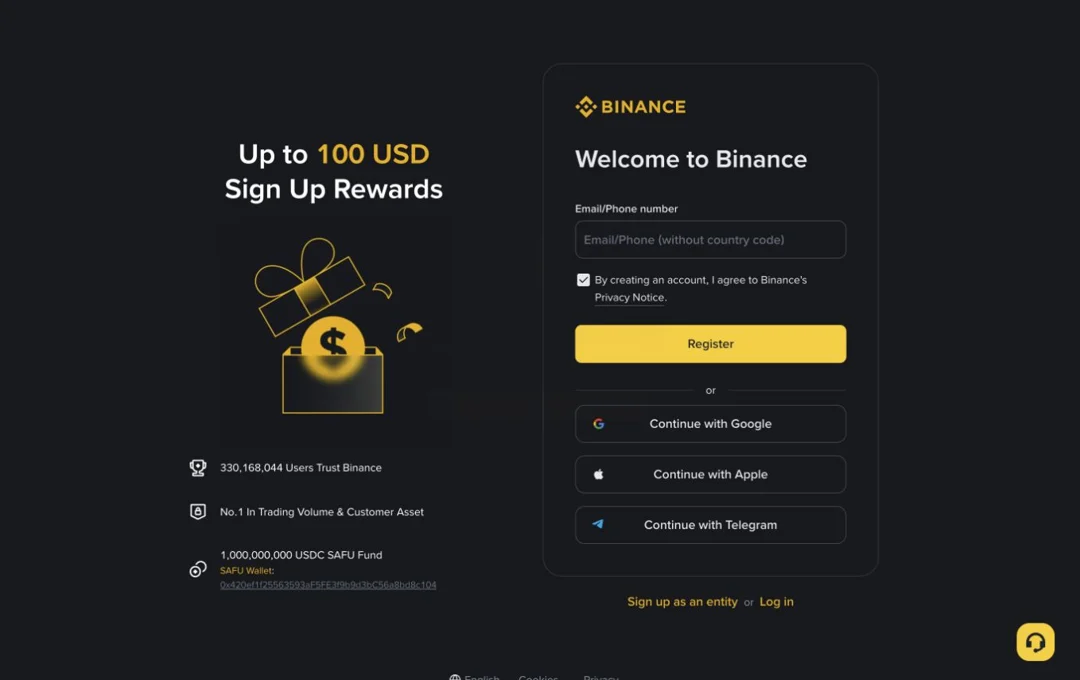
The screen we could inspect without an account has one email-or-phone field and three third-party sign-in options. There is no referral entry box on that first screen. A separate link is labelled for an entity account; a personal account is the relevant choice for an individual using their own funds.
Binance's website registration instructions describe the email verification and password steps, followed by checking whether a referral ID is linked. A linked referral cannot subsequently be changed under that documented flow. Keep access to the original email or sign-in method: losing it can turn a routine login into an account recovery problem.
If you use our optional code, it is BN16188. The button above carries it in the URL. A URL parameter is not proof of successful association. Look for the referral confirmation in the official process before relying on a discount. If the screen does not confirm what you expected, ask official support rather than making a deposit to test it. We have not created an account through this walkthrough or verified an account-specific rebate.
Keep the registration and your email inbox in separate tabs so that you can check where a request came from. Never send an email verification code to someone claiming to finish the process for you. A code copied into a support chat can authorize somebody else's action just as readily as your own.
Identity review is a separate stage
Finishing the sign-up form does not mean that an account is ready for deposits or trading. Binance's identity verification documentation starts from Account → Identification. It asks you to select residence, document-issuing country and document type, then follow the document and liveness checks. Use the options presented for your account; a screenshot from another country is not a document checklist for yours.
Check names, dates and the document's validity before submitting. Keep the image legible and unobstructed, with the document inside the frame. For liveness, follow the on-screen prompts in good light without filters. Additional requests and review times can vary. Wait for the actual result before arranging a time-sensitive payment; a progress indicator is not approval.
A rejected submission and an unavailable service are different problems. Correcting a blurred photo may fix the first. Sending more documents cannot make an unsupported residence eligible. If the reason is unclear, use support reached from the account itself. Do not give a stranger your documents, password or remote access in exchange for a promise to accelerate review.
Do the recovery work while the balance is empty
A new account is easier to secure before it holds money. Binance's account security guide covers unique passwords, a second authentication factor, device review, anti-phishing codes and withdrawal address management. Use an authenticator or an appropriate security key where supported, and store recovery material somewhere that remains available if you lose the phone.
The email account deserves the same attention: it may receive password resets and approval requests. A withdrawal allowlist (Binance labels it "Withdrawal Whitelist") can restrict destinations, but it is not a guarantee against theft, particularly when someone also controls the email used to approve changes.
Two settings sit there rather than one: the allowlist itself, and a separate sub-switch you set to hold any newly added address for 24, 48 or 72 hours before it can receive a withdrawal — that second switch is no longer shown once the allowlist is turned off. Editing the list, or turning the feature off, can itself place the account in a temporary withdrawal pause of the same length; that is what Binance's help page for the feature described when it was last updated in March 2025. Check which duration is selected, and what happens on the day you switch it off. Review the device list and remove unfamiliar access through official security settings. Do not create API keys for a basic manual buying workflow.
There is no need to email yourself a photograph containing every recovery secret. Think through one practical failure instead: your phone is lost while you are away from home. Can you still access email and recover the second factor without exposing both to whoever finds the phone? Resolve that dependency before funding the account.
Three checks before the first deposit
| Check | What you need to establish | If it is unclear |
|---|---|---|
| Payment route | The payment method, currency and account holder match the instructions available to you. | Pause before sending money; registration alone says nothing about a particular bank route. |
| Total cost | The final amount received after fees and the quoted exchange rate, for the actual order method. | Compare the confirmation screen, not a headline fee from a different product. |
| Network and destination | For an on-chain deposit, both ends support the same asset on the same network and any required memo. | Do not send to a familiar-looking address on an unconfirmed network. |
If you are depositing existing stablecoins, read the receiving instructions before copying an address. Matching ticker symbols are not enough. The wrong-network recovery guide explains why an exchange cannot necessarily credit an otherwise successful transfer.
For a first purchase, a small amount you can afford to lose can reveal whether your intended route works, but it does not remove counterparty or payment risk. Save the official receipt and order details. The useful endpoint is being able to reconcile what you paid, what arrived and how you can withdraw it—not simply seeing a successful sign-up message.
When you need the bank side of that route, the stablecoin cash-out guide compares the available approaches. Stop before committing funds if that return route is still uncertain.