
Whether platforms can still sell USDT to people in the US after that date depends on whether its issuer is a permitted issuer by then, or meets the conditions section 18 sets for foreign issuers. Separately, in January 2026 Tether launched USA₮, commonly referred to as USAT, a coin aimed specifically at the US market. With less than two years to go until July 18, 2028, the Treasury rules that interpret this provision are still out for public comment.
| Date | What happened | What it means for USDT |
|---|---|---|
| 2025-07-18 | The GENIUS Act is signed into law as Public Law 119-27 | Starts the three-year clock for section 3(b)(1) |
| 2026-01-27 | Tether announces the launch of USA₮, issued by Anchorage Digital Bank, N.A. | A separate coin under the same brand, built for the US market |
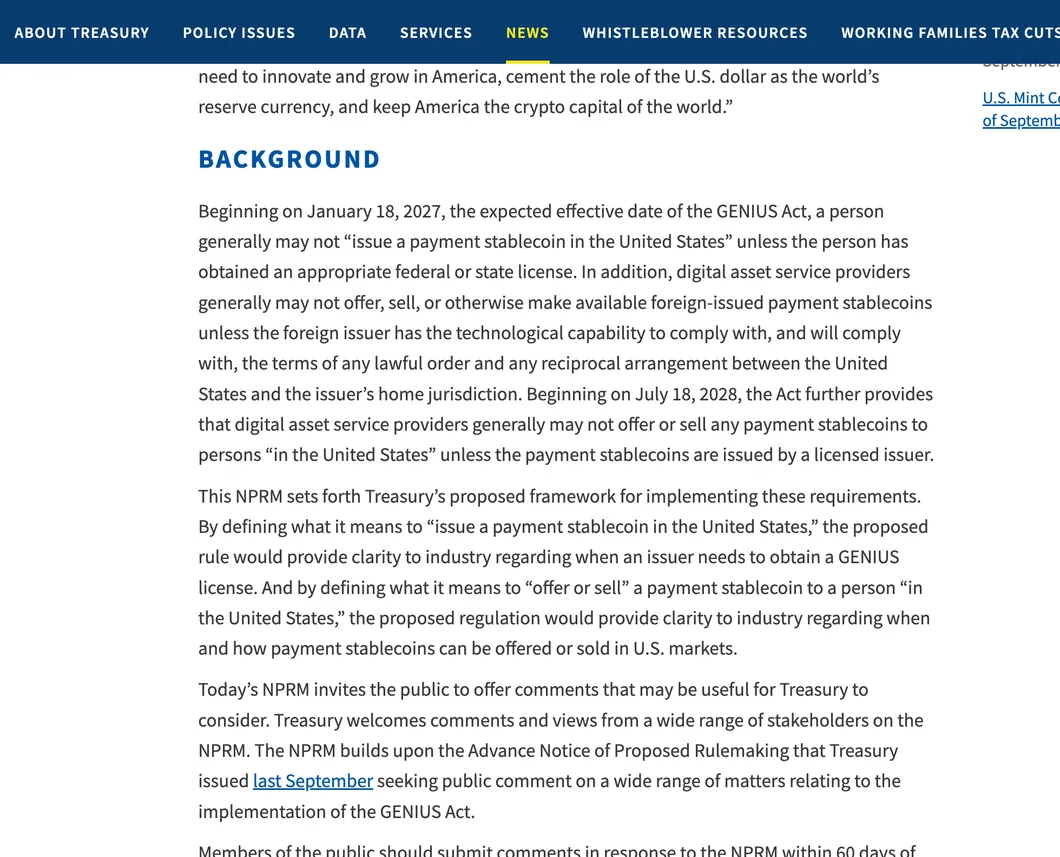
| 2026-08-17 | Treasury releases a proposed rule (NPRM) under section 3 | Sets out what counts as an offer or sale, and who counts as being in the United States |
| 2026-08-18 | The proposed rule is published in the Federal Register as document 2026-16796 | A draft for comment, not yet a final rule |
| 2026-10-19 | Public comment period closes | Submitted comments are posted publicly on regulations.gov |
| 2027-01-18 | The Act's expected effective date, as given by Treasury | Section 3(b)(2) applies from the effective date: a platform selling a foreign issuer's stablecoin needs that issuer to be able to comply with lawful US orders. If final rules come out early, the effective date could move earlier |
| 2028-07-18 | The section 3(b)(1) sales restriction begins | Platforms generally can no longer sell stablecoins from non-permitted issuers to people in the US |
What US law actually prohibits from July 18, 2028
The text of section 3(b)(1) reads: “beginning on the date that is 3 years after the date of enactment of this Act, it shall be unlawful for a digital asset service provider to offer or sell a payment stablecoin to a person in the United States, unless the payment stablecoin is issued by a permitted payment stablecoin issuer”. Here is what its key terms cover:
| Term in the Act | What it covers | Where it's defined |
|---|---|---|
| digital asset service provider | The regulated business category; in the examples in Treasury's draft, a platform that runs an exchange falls into it | Section 2 of the Act |
| offer or sell | Which conduct counts as offering or selling | Treasury's proposed rule (see the next section) |
| a person in the United States | Who counts as being in the US | Treasury's proposed rule (see the next section) |
| permitted payment stablecoin issuer | An issuer approved under the Act; it must be formed in the US and go through a federal or state approval path | Section 2 of the Act |
The prohibition also opens with “Except as provided in subsection (c) and section 18”. Subsection (c) lets Treasury create limited safe harbors, one for very small transaction volumes and one for unusual and exigent circumstances as Treasury determines them; before using the second, Treasury has to send its justification to the relevant committees of the House and the Senate. Section 18 is the exception for foreign issuers, covered further down.
Section 3(e) gives the provision extraterritorial reach whenever the conduct involves offering or selling to a person located in the United States. A platform based outside the US is still within its scope when it sells to people in the US.
Section 3(h)(1) then sets out three kinds of transactions to which section 3 does not apply at all:
- a direct transfer of digital assets between two individuals acting on their own behalf and for lawful purposes, with no intermediary involved;
- receiving digital assets moved between your own account in the US and your own account abroad, where both accounts are offered by the same parent company;
- transactions in which an individual holds their own digital assets in a software or hardware wallet.
Treasury's proposed rule carries all three over in § 1523.4(c). Sending and receiving USDT through a software or hardware wallet you control yourself, or passing it directly to another person with no intermediary, falls on this exemption list.
As for when the Act itself takes effect, section 20 picks the earlier of two dates: 18 months after enactment, or 120 days after the primary federal payment stablecoin regulators issue final rules implementing the Act. The 18-month mark is January 18, 2027, which Treasury's press release calls the expected effective date. The section 3(b)(1) sales restriction runs on its own clock, three years from enactment, which lands on July 18, 2028.
How Treasury's draft decides whether someone is in the United States
Section 3(d) hands the job of defining these terms to Treasury. The proposed rule published on August 18, 2026 defines them this way:
| Who | When they count as being in the United States |
|---|---|
| Individuals | When physically present in the United States; a non-US resident who is only temporarily in the US does not count |
| Companies, partnerships, trusts and other entities | When organized or incorporated under US federal or state law, or when their principal place of business is in the US |
For individuals, what mostly matters is where the person physically is at that moment. Residency only comes into play in one situation, a non-resident on a short visit. An illustrative example in the draft's appendix describes a US resident who receives a foreign issuer's stablecoin while on vacation abroad. It concludes that the issuer did not violate the issuance provision (section 3(a) of the Act, under which an issuer that isn't permitted may not issue a payment stablecoin in the United States), because the resident wasn't in the United States at that moment. The appendix then warns foreign issuers that if the same resident is directly solicited to buy while physically in the US, that would likely violate the offer provision, unless the three conditions in § 1523.3(e) are met: a reasonable basis to believe the buyer is not in the United States, controls in place to prevent sales to people in the US, and no advertising or solicitation aimed at people in the US.
As for what counts as offering to a person in the United States, § 1523.3(d) of the draft lists several examples and notes that the list is not exhaustive:
- directly soliciting people in the US to buy;
- advertising that the stablecoin is available for people in the US to buy;
- responding to an inquiry from someone in the US by saying the platform is willing to sell;
- showing prospective buyers how to get around geolocation or blocking measures such as IP address checks;
- entering into a contract to buy or sell with a person in the US, whatever the form of payment and whenever the coins are delivered.
The other way round, for a platform to be treated as not offering in the United States, § 1523.3(e) requires all three of the following: a reasonable basis to believe the buyer is not in the United States; reasonably designed policies, procedures and controls, actually put into practice, to prevent sales to people in the US; and no advertising or solicitation that targets, or could reasonably be expected to reach, people in the US.
All of this comes from a draft. In the same document, Treasury itself asks for comment on whether the definition is drawn too broadly or too narrowly. Comments close on October 19, 2026, and the wording may change in the final rule.
What a foreign-issued stablecoin needs to stay on sale to people in the US
A foreign issuer's stablecoin first has to clear section 3(b)(2): a digital asset service provider may not offer, sell or otherwise make available in the United States a payment stablecoin from a foreign issuer unless the issuer has the technological capability to comply, and will comply, with any lawful order and with reciprocal arrangements under section 18. This one doesn't wait until 2028. The proposed rule in the Federal Register points out that, unlike section 3(b)(1), section 3(b)(2) applies from the Act's effective date. That is expected to be January 18, 2027. Under section 20 the effective date is the earlier of 18 months after enactment and 120 days after final rules are issued, so if final rules come out early, it could arrive before then. Under § 1523.3(c) of the proposed rule, a platform may rely on the issuer's own representations, provided it has carried out reasonable due diligence; if the platform knows, has reason to know or should know that a representation is false, it can no longer rely on it.
The USDT contract already includes methods for blacklisting addresses, and Tether has publicly described cases where it froze assets in cooperation with US law enforcement; for the details, see How to check whether Tether has frozen a USDT address. That doesn't mean platforms have already concluded that USDT satisfies section 3(b)(2). Under § 1523.3(c), a platform needs a representation from the issuer itself and has to do reasonable due diligence of its own.
For a foreign issuer's coin to keep being sold by platforms to people in the US after July 18, 2028, section 18(a) requires all of the following:
| Condition | What section 18(a) requires |
|---|---|
| Comparable home-country regulation | The issuer is supervised by the stablecoin regulator of its home country or region, and Treasury has determined that the local regime is comparable to the Act, particularly the section 4(a) requirement for identifiable reserves backing the coin at least 1:1 |
| Registration with the Comptroller | The issuer is registered with the Office of the Comptroller of the Currency |
| Reserves held in the US | The issuer holds reserves at US financial institutions sufficient to meet the liquidity needs of US customers, unless a reciprocal arrangement provides otherwise |
| No comprehensive sanctions on the home country | The home country is not subject to comprehensive US economic sanctions and is not a jurisdiction Treasury has designated as a primary money laundering concern |
Whether a local regime is comparable is Treasury's call, and it can only make that determination after every other member of the Stablecoin Certification Review Committee has recommended it; the reasons must be published in the Federal Register before the determination takes effect. A foreign issuer or its regulator can apply, and Treasury must decide within 210 days of receiving a substantially complete application. A determination can also be revoked. After a revocation, platforms have 90 days before any further sales of that issuer's coins count as a violation of section 3. Treasury has to maintain a public list of the jurisdictions that have received a determination.
In its USA₮ launch release, Tether says USDT continues to operate globally and is progressing toward GENIUS Act compliance. Whether USDT will go the section 18 route or rely on some other arrangement, which jurisdiction will supervise it, and on what timeline, are questions the release doesn't answer.
Who issues Tether's USAT (USA₮), and where you can buy it
USA₮ officially launched on January 27, 2026. Tether's announcement positions it as a dollar stablecoin built specifically for the US market under the GENIUS Act's federal framework, open to US users and available for institutions and platforms to integrate. The arrangements listed in the announcement:
- Issuer: Anchorage Digital Bank, N.A., which the announcement calls the first federally regulated stablecoin issuer in the US. Tether Operations, S.A. de C.V., which published the release, notes at the end that it is not the issuer of USA₮;
- Reserve custody: Cantor Fitzgerald is the designated reserve custodian and also the preferred primary dealer;
- First platforms: Bybit, Crypto.com, Kraken, OKX and MoonPay.
The disclaimer at the end of the announcement states that USA₮ is not legal tender, is not issued, backed, approved or guaranteed by the US government, and is not insured by the FDIC, SIPC or any other government agency.
On how USDT and USA₮ split the roles, Tether puts it this way: “While USD₮ continues to operate globally and leads as the world’s most widely adopted stablecoin, progressing towards GENIUS Act compliance, USA₮ is purpose-built for the U.S. market”. USA₮ is issued by Anchorage Digital Bank, and its licensing and reserve arrangements can't simply be read across to USDT. The announcement doesn't say which blockchains USA₮ runs on, or whether users outside the US can buy it.
Should USDT holders outside the US worry about the 2028 rule?
Section 3(e) says the provision reaches beyond US borders whenever an offer or sale to a person in the United States is involved. Under the draft definition, what counts for individuals is whether they are physically in the US; a non-US resident on a short visit doesn't count. Sending and receiving through a software or hardware wallet you control yourself, and direct transfers between two individuals acting on their own behalf, for lawful purposes and with no intermediary, are among the exclusions in section 3(h)(1).
For people who use trading platforms, any change is more likely to show up in how platforms identify users who are in the US. Under the draft, a platform that wants to show it didn't offer into the US needs a reasonable basis plus controls it actually enforces, and a platform that coaches users on getting around IP checks is, by the draft's own terms, offering into the US.
The GENIUS Act only covers the US side. How USDT is treated where you live is governed by a separate set of local rules.
Where to follow what happens next
Between now and 2028, the documents that will decide where USDT stands in the US are spread across several official websites:
| Document | Where to find it | What to look for |
|---|---|---|
| Proposed rule docket TREAS-DO-2026-0496 | regulations.gov | Comments can be submitted until October 19, 2026, and those already submitted are publicly readable |
| Final rule under section 3 | Federal Register, federalregister.gov | The final wording of what counts as an offer or sale and who counts as being in the United States, and whether it differs from the draft |
| List of comparable jurisdictions | The list Treasury publishes under section 18(b)(5) | Which countries or regions have stablecoin regimes judged comparable to the US one |
| GENIUS Act text | govinfo.gov, Public Law 119-27 | Section 3 on the prohibitions and exemptions, section 18 on foreign issuers, section 20 on the effective date |
Frequently asked
Can Americans still hold USDT after 2028?
Section 3(b)(1) of the GENIUS Act restricts digital asset service providers from offering or selling to people in the United States. It is aimed at platforms selling coins; what individuals already hold is not covered by the text. Section 3 also excludes transactions in which individuals keep their own coins in a software or hardware wallet, and direct transfers between two individuals acting on their own behalf, for lawful purposes and with no intermediary. Whether platforms keep selling USDT depends on the final rule and on how each platform implements it.
Where can I buy USAT?
Tether's January 27, 2026 release says the first phase launches on Bybit, Crypto.com, Kraken, OKX and MoonPay, with Anchorage Digital Bank, N.A. as the issuer. The coin is positioned as built for the US market, so whether a given platform offers USA₮ where you live depends on that platform's own asset and regional availability notes.
When does the GENIUS Act take effect?
Section 20 takes the earlier of two dates: 18 months after enactment, or 120 days after the primary federal payment stablecoin regulators issue final rules implementing the Act. The Act became law on July 18, 2025, so the 18-month mark is January 18, 2027, which Treasury calls the expected effective date. The restriction on platform sales runs on its own three-year clock and starts on July 18, 2028.
Can I still comment on Treasury's proposed rule?
The comment deadline is October 19, 2026. You can submit online in docket TREAS-DO-2026-0496 on regulations.gov, or by mail to Treasury's Office of the General Counsel at 1500 Pennsylvania Avenue NW, Washington, DC 20220. Treasury's press release says comments received will be posted publicly on regulations.gov.