
- Work out which layer it's stuck in. If the coins are in an exchange account and the withdrawal is being blocked, that's the platform. Only when the coins are in your own wallet and the transaction fails as soon as it's sent does the chain itself come into it.
- Read the blacklist straight from the contract. For an Ethereum address, read
isBlackListedon the USDT contract in Etherscan. For a TRON address, find the blacklist query on the contract's Read page in Tronscan. Neither needs a login. - If it reads true, the party you're dealing with is now Tether. Neither your wallet nor an exchange can lift the freeze, and the only appeal route runs through Tether. This is also when you most need to watch out for people offering to “unfreeze” it for a fee.
Stuck in the wallet, the platform or on-chain?
The symptoms overlap across the three layers, but who you need to deal with is completely different. Sort it by where the coins are held and at which step the failure happens, and you'll rarely get it wrong:
| Where it's stuck | Typical symptoms | Who to contact |
|---|---|---|
| Wallet | The transaction was never broadcast; not enough for the network fee; the wrong network was selected | Check your wallet settings and the network fee; before switching networks, confirm which chain the recipient supports |
| Platform | The coins are in an exchange account; the withdrawal request is rejected or account features are restricted | The platform's official support and its in-app notices |
| On-chain (Tether blacklist) | The wallet still shows the balance as normal; the transaction fails or is rejected once it reaches the chain | Tether |
An on-chain freeze is confusing to look at from inside a wallet. The balance is all there, yet transfers fail or hang, the chain shows the transaction as rejected, and some block explorers tag the address as “blacklisted” or “frozen” (TokenPocket Help Center, article on frozen USDT on TRON). It's easy to mistake this for a wallet glitch and keep resending, when in fact the contract is bouncing the transaction back every time.
There's another kind of “my money won't move” that has nothing to do with the chain: after you sell USDT over P2P, the bank card that received the payment gets frozen. What's frozen there is the fiat in the account, and the parties to deal with are the bank and the investigating authorities. The steps are in Tainted USDT and Frozen Bank Accounts · What to Do. An issuer freeze, a platform restriction and a frozen bank card each have a different party in control and a different appeal route, and none of those routes connects to the others (Is a Stablecoin Safe? Four Risks Worth Pricing (2026)).
The blacklist is written into the USDT contract
On Ethereum, the USDT contract address is 0xdac17f958d2ee523a2206206994597c13d831ec7. Its source code is publicly verified on Etherscan and you can read it on the Contract tab. Two checks bear directly on freezing:
transfer()containsrequire(!isBlackListed[msg.sender]);— if the address sending the transfer is on the blacklist, the transaction fails.transferFrom()containsrequire(!isBlackListed[_from]);— someone holding an approval who tries to pull tokens out of that address is blocked the same way.
Both checks target the side the money leaves from. The receiving address is outside the scope of these two checks.
| Contract method | What it does | Who can call it |
|---|---|---|
isBlackListed(address) | Read: whether this address is on the blacklist, returning true / false | Anyone (read-only) |
getBlackListStatus(address) | Read: also returns true / false | Anyone (read-only) |
addBlackList | Adds an address to the blacklist | Contract owner |
removeBlackList | Removes an address from the blacklist | Contract owner |
destroyBlackFunds | Destroys the balance held by a blacklisted address | Contract owner |
All three write methods sit behind owner permissions, so an ordinary address can't call them. destroyBlackFunds really is in the contract; which address it gets called on, and when, is the issuer's decision. Once an address has been added to the list, that status stays on-chain for as long as nobody calls removeBlackList. Left alone, it doesn't lapse.
Checking an Ethereum address on Etherscan
The whole check runs in a browser and needs no account:
- Go to etherscan.io and paste the USDT contract address
0xdac17f958d2ee523a2206206994597c13d831ec7into the search box. Make sure the page title reads Tether: USDT Stablecoin, so you don't end up on a copycat contract. - Switch to the Contract tab, then open Read Contract.
- Find
isBlackListedin the list of methods, enter the address you want to check in the input box (the wallet address starting with 0x, not a transaction hash) and submit the query. - If the result is
true, the address is on the blacklist. If it'sfalse, it isn't.
Step one is where people most often get stuck. Paste your own address into the search box and you land on your address page, which has no Read Contract. Put a transaction hash into isBlackListed and the format won't match, so you won't get a meaningful result. If it returns false and your transfers still fail, go back to the table in the first section: the problem most likely sits at the wallet or platform layer. What the Ethereum contract returns only tells you the status of an Ethereum address. For USDT on TRON, use the method in the next section.
For USDT on TRON, look on Tronscan
USDT on TRON is a separate contract, at TR7NHqjeKQxGTCi8q8ZY4pL8otSzgjLj6t. Open it on Tronscan and the contract interface lists the same addBlackList, removeBlackList and destroyBlackFunds, with method names identical to the Ethereum version.
The query works much the same way: go to this contract's Read page, find the read-only method with BlackList in its name, and enter your address, the one starting with T.
As for why TRON addresses get frozen, the TokenPocket help page lists several categories: suspected money laundering, fraud or other illegal activity; requests from law enforcement; breaches of Tether's terms of use or its anti-money-laundering policy; links to hacks or theft; and appearing on a sanctions list such as OFAC's.
What gives Tether the power to freeze
Technically, it rests on the contract methods above. As for the rules, they're set out in two places: Tether's terms of service, and its cooperation with law enforcement agencies in different countries.
Tether's terms of service (tether.to/en/legal) state that Tether may “suspend or terminate your access to the Site or any of the Services, freeze any Tether Tokens held by you, or terminate your Tether Token Wallet”. The triggers include what applicable law requires, Tether's own judgment that it is necessary, and a user breaching the terms. That sentence binds direct users who have opened a wallet account with Tether. Among the measures the terms list for Prohibited Use, there is also blacklisting addresses that hold Tether tokens. The terms' definition of “Sanctioned Person” counts addresses directly as well, so an address that appears on a sanctions list such as OFAC's SDN list is within scope in its own right.
On April 23, 2026, Tether published an announcement saying it had helped the U.S. government freeze $344 million in USD₮ held at two addresses, following information on illegal activity supplied by several U.S. agencies. The announcement says that once a wallet is identified as linked to sanctions evasion, criminal networks or other illicit activity, Tether can restrict the assets in it, and it describes freezing funds in cooperation with law enforcement as routine company work in responding to lawful requests. The same announcement gives the scale of that cooperation (as of the April 2026 announcement):
| Item in the announcement | Figure |
|---|---|
| This freeze | $344 million in USD₮, across two addresses |
| Law enforcement agencies it works with | More than 340, in 65 countries |
| Cases assisted | More than 2,300, over 1,200 of them involving U.S. law enforcement |
| Assets frozen with its help | More than $4.4 billion, over $2.1 billion of it linked to U.S. agencies |
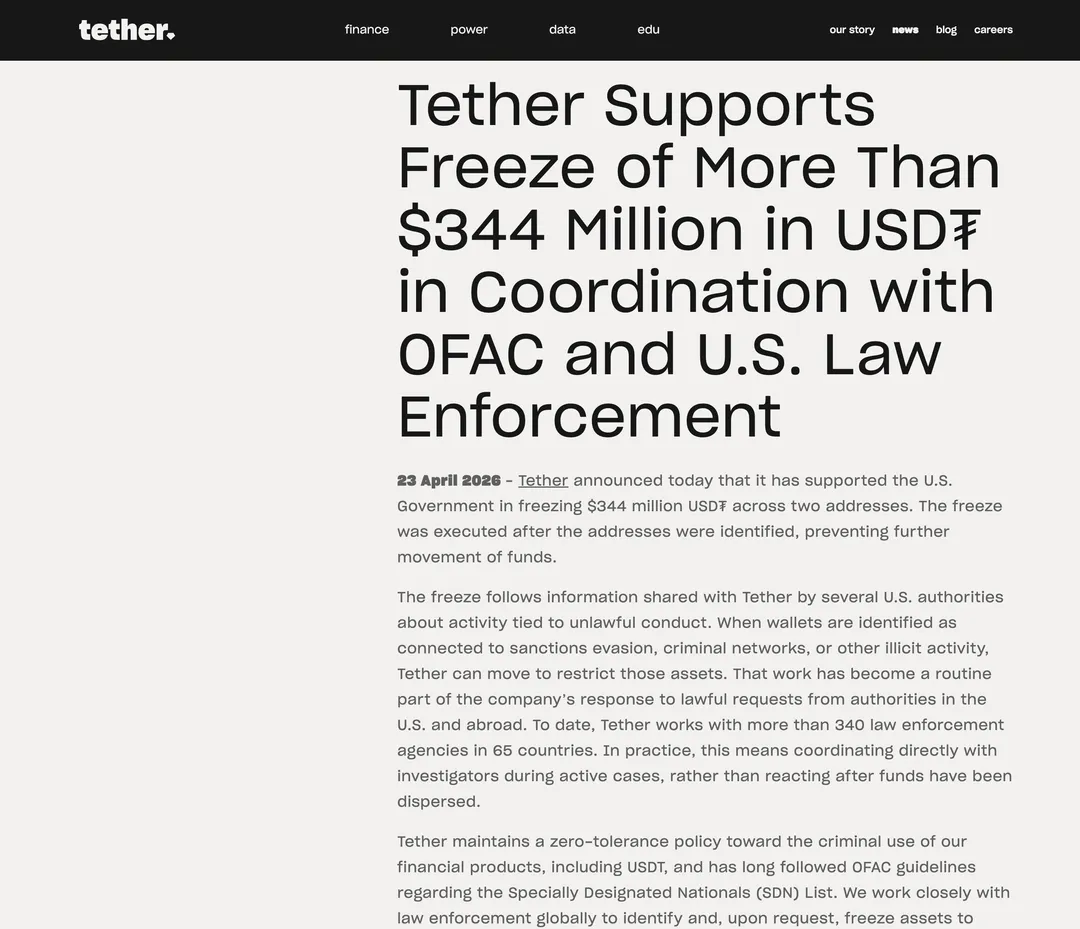
The announcement also says Tether has consistently followed OFAC's guidance on the SDN list. Across the terms and the announcement, the triggers that come up fall into these groups: a request from law enforcement, an address appearing on a sanctions list, a user breaching the terms, and Tether's own judgment that action is necessary.
If the address is blacklisted: who to appeal to
Your wallet can't help. TokenPocket's help page states that TokenPocket cannot directly or indirectly interfere with, or freeze, any asset on the chain. To deal with a freeze, it suggests going to Tether's website at tether.to or submitting a request at cs.tether.to.
Before you submit, get your materials together. The more complete, the better:
- The frozen address, stating clearly whether it's on Ethereum or TRON
- The transfer records and transaction hashes for that address, especially the ones whose source you can account for
- Proof of where the funds came from, such as exchange withdrawal records, trade orders, contracts or payment receipts
- Identity documents, submitted when Tether asks for them and in the form it asks for
The TokenPocket help page also notes that Tether may ask for additional identity verification or proof of the source of funds, and that the materials need to be genuine and complete. Keep all your email correspondence about the appeal, and don't delete any of it. If the coins were withdrawn from an exchange, keep the withdrawal record on that platform too; it's the most direct piece of evidence for where they came from. If a bank card has been frozen at the same time, that goes through the bank and the investigating authorities separately, and an on-chain appeal won't take its place.
Paid “unfreezing” is always a scam
Once an address is frozen, people often turn up saying they can unfreeze it for you if you pay. The contract's permissions settle the question: an address only comes off the blacklist through removeBlackList, and only the contract owner can call it. Nobody outside Tether can unfreeze it. However convincing a paid fixer sounds, it's a scam.
The lines they typically use fall apart once you hold them up against the contract:
| What they say | Why the contract rules it out |
|---|---|
| Pay an unfreezing fee and it's sorted | Only the contract owner can call removeBlackList to take an address off the blacklist; someone charging you a fee can't |
| A “Tether support agent” who adds you privately | The only official entry points are tether.to / cs.tether.to |
| Verify with your seed phrase | Unfreezing never needs your private key; hand it over and you lose even the coins that aren't frozen |
Frequently asked
Can frozen USDT be unfrozen?
Lifting a freeze depends on removeBlackList in the USDT contract, a method only the contract owner can call; TokenPocket's help page also states that the wallet cannot interfere with on-chain assets. If you believe the freeze is a mistake, you can submit an explanation through tether.to or cs.tether.to, with the frozen address, the related transaction records and proof of the source of funds attached.
How do I check if my USDT address is frozen?
For an Ethereum address, open the USDT contract on Etherscan, go to Contract → Read Contract and enter your address in isBlackListed; a result of true means it is on the blacklist. For a TRON address, open the Read page of the TRON USDT contract on Tronscan and find the blacklist query. Neither needs a login.
Will sending USDT to a frozen address fail?
The transfer checks in the Ethereum USDT contract target the sender: transfer checks msg.sender and transferFrom checks _from, and the source code has no equivalent check on the recipient. What the contract blocks is the frozen address sending funds out, so once money lands in a frozen address, any later attempt to move it out will be rejected. Don't send money to suspicious addresses.
Why can Tether freeze USDT?
Technically, it relies on methods such as addBlackList in the USDT contract, which only the contract owner can call. On the rules side, Tether's terms of service state that it can freeze tokens held by users and blacklist addresses that hold Tether tokens. According to its April 2026 announcement, it works with more than 340 law enforcement agencies in 65 countries and follows OFAC's SDN list.
Does frozen USDT get destroyed?
The contract does include destroyBlackFunds, which can destroy the balance held by a blacklisted address, and only the contract owner can call it. Which address it is called on, and when, is the issuer's decision. Once an address is frozen, what you should do is gather the address, the transaction records and proof of the source of funds, and go through Tether's official appeal channel.