
Circle's USDC terms (which apply only to holders outside the European Economic Area) and Tether's terms of service, in their current versions, both leave out the order in which holders get their dollars back if the issuer of USDT or USDC itself goes bankrupt. What the two documents cover is who can redeem directly with the issuer, at what price, and how the reserves back the tokens. Bankruptcy here means the issuer's own; if the exchange holding your coins collapses, that is dealt with separately under the exchange's own procedure.
The GENIUS Act, signed into law on July 18, 2025, provides in section 11 that when a permitted payment stablecoin issuer enters insolvency proceedings, holders' claims on the required reserves take priority over the issuer and its other creditors, and holders are paid ratably among themselves. The section applies only to permitted issuers, and only once the Act has taken effect. Under this rule, how much your coins can be exchanged for depends on whether the issuer is a permitted issuer and whether the required reserves are enough to pay every holder's claim; if they fall short, each holder receives a proportional share.
What the USDC and USDT issuer terms say about redemption eligibility and reserves
What a holder can assert directly against the issuer is the redemption right the terms grant, and both sets of terms give that right only to some holders.
| Issuer | Who can redeem directly with the issuer | Redemption price | What the terms say about reserves | Arrangements if the issuer goes bankrupt |
|---|---|---|---|---|
| Circle (USDC) | Only Type A users, meaning holders of a Circle Mint account | 1 USDC for 1 US dollar, subject to the terms, applicable law and applicable fees | Held in segregated accounts at regulated US financial institutions, separate from the issuer's corporate funds, on behalf of and for the benefit of users; interest or other earnings on the reserves do not go to users | Nothing in the terms |
| Tether (USDT) | Must be a verified customer of the issuer; the right to buy and redeem belongs to the customer alone | One token for one unit of the fiat currency it is pegged to, US$1 for USDT; subject to requirements such as a minimum redemption amount | Each token in circulation is 100% backed by assets of equal value; the reserves consist of cash, cash equivalents and other assets, which may include loan receivables from related parties | Nothing in the terms; the User Insolvency Event the terms define covers situations such as the user's own inability to pay debts |
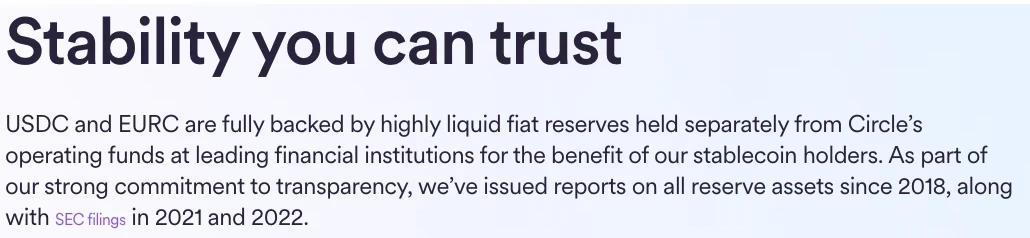
Actual minimums and fees are listed in the thresholds for redeeming USDT and USDC directly with the issuer. On the USDC side, the issuer adds a sentence on its transparency page to the effect that USDC and EURC are fully backed by highly liquid fiat reserves, kept apart from the company's operating funds and held at major financial institutions for the benefit of stablecoin holders.
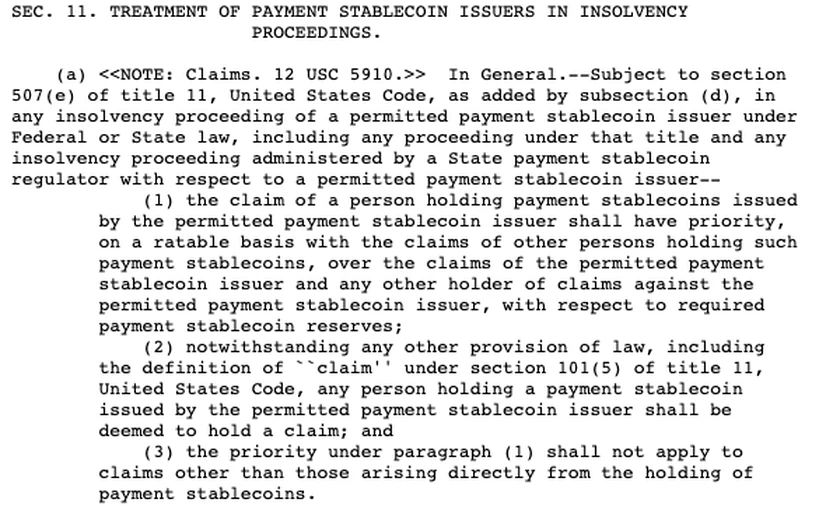
GENIUS Act section 11 gives holders of a permitted issuer's coins first claim on the required reserves
Section 11 applies to any insolvency proceeding of a permitted issuer under Federal or State law, including proceedings under the US Bankruptcy Code and those run by a State payment stablecoin regulator. The required reserves are the reserves the Act requires an issuer to hold against the stablecoins it has issued. The order the provision sets out is:
- Holders' claims have priority on the required reserves over the issuer itself and over any other person with a claim against the issuer; among themselves, holders are paid ratably.
- However other law defines a claim, a person holding the issuer's payment stablecoins is deemed to hold a claim.
- The priority covers only claims arising directly from holding payment stablecoins; other claims do not get it.
To put ratable payment into numbers, suppose the reserves cover only 90% of all holders' claims and each token is claimed at $1. Each holder then receives 90% of their claim from the reserves, so someone holding 1,000 tokens gets $900 and someone holding 100,000 tokens gets $90,000.
For the unpaid 10%, section 11 changes the order of payment under bankruptcy law. Whatever part of a holder's claim the required reserves cannot cover counts as a claim against the bankruptcy estate and ranks first, ahead even of the expenses and claims that already have priority under bankruptcy law. This first rank has a limit: it covers only the amount of reserves the issuer would have held in addition had it complied with the Act's reserve requirements.
The required reserves themselves are not part of the bankruptcy estate, but the automatic stay under bankruptcy law still applies to them, and section 11 also adds redemption of the issuer's payment stablecoins from the required reserves to the matters the stay covers. The automatic stay means that as soon as a bankruptcy petition is filed, collection, enforcement and similar actions against the debtor and its property are put on hold.
The provision also sets out how payouts begin once everything is on hold. The issuer files a motion and certification on the day it files for bankruptcy or as soon as practicable afterwards; where the court finds on that basis that reserves are available for ratable distribution to similarly situated holders, it is to use its best efforts to issue a final order to begin distribution within 14 days after the required hearing. After a filing under the US Bankruptcy Code, holders' redemptions from the reserves don't go ahead as usual; they wait for this order. The 14 days refer to the order to begin distribution, not to the time money reaches holders.
When does GENIUS Act section 11 take effect at the latest, and which issuers does it cover?
Section 11 applies only to permitted payment stablecoin issuers, and under section 20 it takes effect on the earlier of two dates: 18 months after enactment, or 120 days after the primary Federal payment stablecoin regulators issue any final regulations implementing the Act.
The Act gives a precise definition of a permitted issuer: it must be formed in the United States and be one of three kinds of entity, namely a subsidiary of an insured depository institution approved to issue payment stablecoins, a Federal qualified payment stablecoin issuer, or a State qualified payment stablecoin issuer. If an issuer is none of the three, the section 11 order doesn't apply to it. For coins from such issuers, the Act separately restricts digital asset service providers from selling them to people in the United States, starting 3 years after enactment, with exceptions written in.
The Act was signed on July 18, 2025, and 18 months after enactment falls on January 18, 2027 by the calendar. For it to take effect any earlier, final regulations would have to be issued first and 120 days would have to pass after that.
New York's 2022 guidance requires segregated reserves for the dollar stablecoins it supervises
Before the GENIUS Act, there were already written requirements at state level. The New York State Department of Financial Services (DFS) guidance on issuing US dollar-backed stablecoins, published on June 8, 2022, applies only to US dollar stablecoins issued under its supervision by virtual currency entities it regulates. For those coins, it will generally attach the following conditions.
- The reserve assets are segregated from the issuing entity's proprietary assets, held in custody with federally insured state or federally chartered depository institutions and/or asset custodians approved in advance by DFS in writing, and held for the benefit of holders.
- A redemption policy approved in advance by DFS in writing gives any lawful holder the right to timely redemption at par, that is 1 token for US$1, net of ordinary, fully disclosed fees; reasonable, non-onerous conditions may be attached, such as the holder first passing the issuer's onboarding checks.
- The redemption policy must state what timely means, or expressly adopt the default: no more than two full business days (T+2) after the business day on which the issuer receives a compliant redemption order. A compliant redemption order requires that the issuer has received the order, that the holder (or their designee) has completed onboarding, and that any other necessary conditions are met.
T+2 has an exception as well. In extraordinary circumstances, where DFS finds that timely redemption is likely to jeopardize full backing of the reserve or the orderly liquidation of reserve assets, it may require or permit redemptions that don't meet the timeliness standard.
Check your stablecoin's issuer, its regulator and your right to redeem
Who the issuer is and where it is regulated is the first thing to establish. Read the terms on the issuer's website, find the company that issues the coin, then compare it with the three kinds of permitted entity the Act defines and with the scope of the New York guidance. If it fits none of them, neither section 11 nor the state guidance reaches it, and which rules would apply if the issuer went bankrupt is a matter for the law where the issuer is based, which you would need to look up separately.
Next, read the sentences in the terms about reserves. Some say the reserves are kept apart from company funds and held for holders' benefit; others only say what assets make up the reserves. Who gets paid first once the issuer is bankrupt is still decided by the applicable insolvency rules.
Then check whether you yourself can redeem directly. The two sets of terms give direct redemption to Type A users and verified customers, and the USDC terms also state that Type B users cannot redeem with the issuer until they open a Circle Mint account. If your coins are held only in an on-chain address, the $1 redemption route in the terms first requires you to get through account opening or verification.
If your coins are held in an account on an exchange, you also have to allow for something going wrong at the exchange itself. When an exchange stops withdrawals, troubleshooting a stuck withdrawal and filing a claim have to follow the exchange's own announcements and terms.
Follow-up questions from holders on protection and redemption limits
What does it mean that USDT is not protected by the FDIC or SIPC under its terms?
It means that holding these tokens brings no protection from the US Federal Deposit Insurance Corporation (FDIC) or the Securities Investor Protection Corporation (SIPC), and that similar protections in other jurisdictions don't apply either; this is how the USDT terms of service describe its tokens. The kind of arrangement in which deposit insurance pays out when something goes wrong with a bank deposit does not cover these tokens.
Does the GENIUS Act guarantee that holders get all their dollars back?
Section 11 sets an order of payment, and whether holders are paid in full is still a question the Act calls for a study on. Holders of a permitted issuer's coins have priority on the required reserves and share ratably among themselves, and any shortfall ranks first within set limits. On whether holders can be paid in full, the Act requires the primary Federal payment stablecoin regulators to cover it in a study and report to the relevant committees of the Senate and the House of Representatives within 3 years of enactment.
Can redemptions be suspended while the issuer is operating normally?
Both sets of terms reserve the right to suspend. The USDT terms of service say the issuer may, at its discretion, delay or suspend your use of the website and services, buying and redeeming included. The USDC terms state for Type A users that the issuer may refuse to process any issuance or redemption without prior notice and may restrict or suspend the related services at any time, a right subject to applicable law and licensing obligations.