The four eras
It is useful to divide the twelve years into four eras. The first (2014-2017) is the prototype era — Tether emerges, MakerDAO is built, the category exists but is tiny. The second (2018-2020) is the consolidation era — USDT and USDC become the dominant pair, exchanges adopt them as quote assets, the first major depeg happens. The third (2021-2022) is the boom-and-bust — DeFi summer, algorithmic experimentation, Luna's collapse. The fourth (2023-2026) is the regulatory era — SVB / Circle, BUSD wind-down, MiCA, HKMA, the first regulated frameworks at scale.
| Period | Development | USDT | USDC | Other designs |
|---|---|---|---|---|
| 2017 | More on-chain dollar designs | Ethereum deployment | Not yet launched | Single-Collateral Dai launches |
| 2018 | Issuer choice expands | Reserve controversy | Launch | Competing reserve-backed tokens |
| 2019 | Exchange and collateral models develop | NYAG investigation becomes public | Exchange integration | BUSD and Multi-Collateral Dai |
| 2020 | DeFi use expands | Trading and transfer use | Collateral use | Maker liquidation stress |
| 2021 | Backing and incentives draw scrutiny | NYAG and CFTC settlements | Reserve-backed model | UST and Anchor expansion |
| 2022 | Market stress | Commercial paper exit announced | Reserve-backed model | UST and LUNA collapse |
| 2023 | Banking and issuance disruptions | Different exposure from USDC | SVB reserve access disrupted | BUSD minting halt; PYUSD launch |
| 2024 | MiCA stablecoin rules apply | Venue-specific restrictions | Circle France EMI authorisation | PYUSD expands to Solana |
| 2025 | Corporate and legal changes | El Salvador relocation announced | Circle parent IPO | GENIUS Act enacted; HK regime starts |
| 2026 | Implementation and disclosure | Read dated reserve reports | Audited 2025 annual filing available | Check each issuer's actual authorisation |
The table tracks developments, not a supply series. A defensible growth calculation needs the same token coverage, valuation method and snapshot convention at both endpoints. DeFi adoption, trading demand and regulation are relevant context, but a supply chart alone cannot establish which one caused a change.
Era 1 · The prototype years (2014-2017)
Era 2 · The consolidation years (2018-2020)
Era 3 · Boom and bust (2021-2022)
Era 4 · The regulatory years (2023-2026)
The headline lesson from twelve years
Five sub-arcs that ran in parallel
The fiat-backed convergence
Cash and short-dated government instruments are central to many fiat-backed designs, but reserve models have not become identical. Some include loans, gold or digital assets; crypto-collateralised and synthetic-dollar designs add different risks. Asset categories still matter alongside banks, accountants and jurisdictions.
The algorithmic disappearance
UST's collapse made the danger of relying on a volatile companion token clear. DAI belongs to a collateralised model, not a surviving UST-style algorithmic one. A companion token's market capitalisation exceeding stablecoin supply is not a solvency test: selling pressure can destroy the value assumed by that comparison.
The cross-chain expansion
USDT in 2014 was a single-chain product (Bitcoin / Omni). By 2026 USDT exists on Ethereum, Tron, Solana, Avalanche, BSC, Polygon, Arbitrum, Optimism, Aptos, Sui, Ton, Near and a dozen smaller chains, with bridges and native deployments across most. The same pattern holds for USDC. The cross-chain expansion has produced its own risk class (bridge exploits, chain-specific deployments with different security profiles) but has also made stablecoins meaningfully more useful as a payment rail.
The supervisory build-out
Dedicated stablecoin frameworks now sit alongside existing financial laws. MiCA, Hong Kong's regime and the US GENIUS Act have different scopes and implementation timetables. US state money-transmission licences and FinCEN registration are also distinct; registration is not a federal money-transmitter licence.
The use-case diversification
Stablecoins began as exchange settlement assets. They are now used for cross-border remittance (Tron USDT in Southeast Asia and Latin America), corporate treasury (USDC for crypto-native firms), commerce payments (PYUSD, USDC on Stripe), DeFi collateral (USDC and DAI), short-term yield (USDC, USDT, FDUSD in money-market-style products), and as functional dollar substitutes in jurisdictions with currency restrictions (multiple tokens, deeply distributed). The breadth of use-case is the single largest difference between the 2017 sector and the 2026 sector.
What the next twelve years probably look like
Three possible trajectories, rather than a probability-ranked forecast:
Continued infrastructure deepening. More payment and treasury uses could develop if integration, cost and legal access improve. That scenario does not imply a particular supply total or issuer market share.
Central bank digital currency interaction. Public and private settlement systems could connect or compete. A pilot does not establish a launch date, an integration standard or a settled division of use cases.
A consolidation event. A material adverse event affecting one of the major issuers (a custodian failure, a sustained reserve dispute, a regulator action of unprecedented scale) produces an industry consolidation. Supply migrates toward two or three winners. The sector shrinks in name but not in total value. This is the lower-probability outcome but is non-trivial.
What we do not expect: the disappearance of fiat-backed stablecoins, the success of a new generation of algorithmic models, or the replacement of the dollar-denominated dominant share with a currency basket. The pattern has stabilised enough that radical breaks are unlikely in the next several years.
Twelve-year reference shelf
- CoinGecko and DeFiLlama historical supply data for USDT, USDC, BUSD, DAI, UST, EURC, FDUSD, PYUSD, 2014 through current.
- Tether and Bitfinex disclosures including the Whitepaper (2014), NYAG settlement (2021), CFTC settlement (2021), quarterly attestations from 2021-present (earlier monthly attestations 2017-2020).
- Circle press releases and SEC filings: USDC launch in September 2018, Centre changes in 2023, and the June 2025 IPO followed by public-company reporting.
- Maker's December 2017 Dai white paper and historical timeline; Single-Collateral Dai launched in December 2017 and Multi-Collateral Dai in November 2019.
- Paxos / Binance BUSD launch announcements (September 2019), NYDFS Consumer Alert (February 2023), Paxos BUSD product page as last updated September 2026.
- Terraform Labs disclosures, Anchor Protocol documentation, LFG public statements May 2022; Chainalysis and Nansen analyses of Terra collapse.
- Regulation (EU) 2023/1114 (MiCA), Hong Kong's Stablecoins Ordinance (2025), MAS stablecoin framework (2023), and applicable NYDFS guidance.
- Coinbase, Kraken, Binance, OKX historical ticker data for major depeg events.
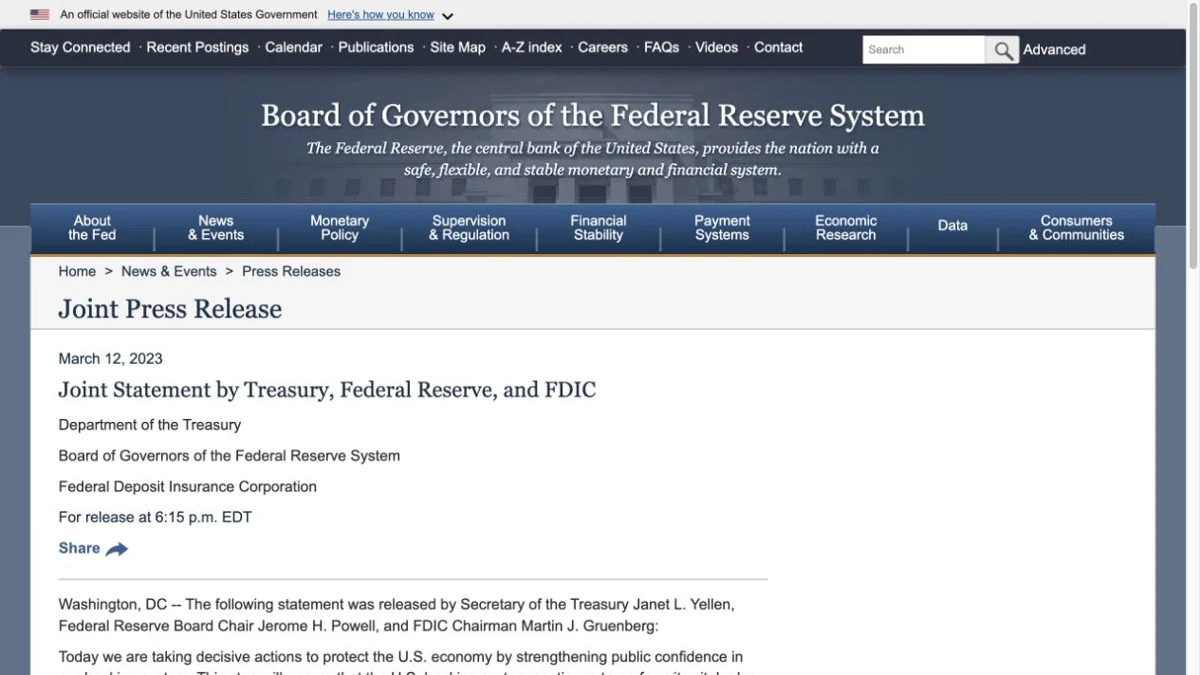
- FDIC and Treasury joint statement on SVB (March 12, 2023); Bank Term Funding Programme terms (March 2023-March 2024).
Corrections, additions, or alternative readings of any event in the timeline are welcome. Write to [email protected]; the corrections log is on the corrections page.