The thirty-second version
The Office of the New York Attorney General (under Letitia James) investigated Bitfinex and Tether between November 2018 and February 2021. The investigation centred on whether Bitfinex had used Tether's reserves to cover an $850 million shortfall caused by the loss of funds at a payment processor called Crypto Capital, and whether Tether had misrepresented those reserves to the public.
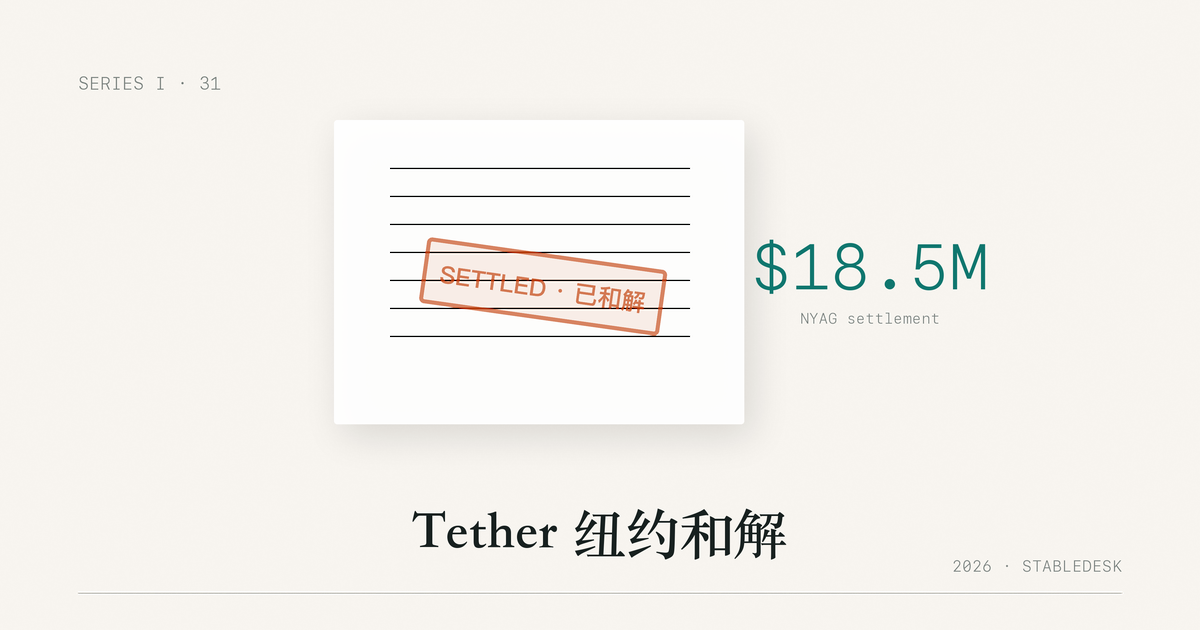
The settlement was announced on February 23, 2021; the agreement is dated February 17. The respondents neither admitted nor denied the OAG's findings. It imposed an $18.5 million payment, New York business restrictions and reporting obligations. This civil settlement resolved the specified New York matter, not every possible claim by every authority.
How the investigation started
In 2018, Bitfinex (the exchange) and Tether (the stablecoin issuer) shared overlapping ownership and management. Both were operated by entities controlled by iFinex Inc. Bitfinex routed customer fiat through a payment processor called Crypto Capital Corp., based in Panama. In October 2018, Crypto Capital's accounts were seized by authorities in Poland, Portugal and the United States in connection with money-laundering investigations involving other clients. Roughly $850 million of Bitfinex customer funds were trapped or lost.
Paragraph 48 of the agreement says the earlier $625 million transfer from Tether was incorporated into a credit line allowing Bitfinex to draw up to $900 million. Those amounts must not be added as two separate loans. The public disclosure problem concerned both the inaccessible Crypto Capital funds and the use of Tether's reserves.
What the OAG found
The settlement document, available through the OAG's press archive, lays out specific findings. The three that matter for stablecoin holders today:
Finding 1. The OAG found that the dollar-backing representations did not match the arrangements during the periods investigated. Those historical findings should be read with their dates; they are neither a present reserve audit nor a clean bill of health.
Finding 2. The OAG described failures to disclose Bitfinex's liquidity problems and the transfers from Tether. The relevant chronology is in the agreement; an unexplained duration is less useful than identifying which transfer and which disclosure are being compared.
Finding 3. A civil settlement is not a criminal conviction, but that distinction does not erase its adverse findings. It would be misleading to reduce the case to a harmless difference in asset labels.
The two-year disclosure regime
The agreement contains both reporting to the OAG and a public reserve-composition requirement. These are separate obligations; it is incorrect to describe the public breakdowns as merely voluntary compliance with the spirit of the settlement.
The disclosure regime preceded BDO Italia's engagement. Tether's August 18, 2022 announcement says work with BDO began in July 2022. Earlier reports should retain their actual accountant's name.
What the reserve breakdowns showed (2021 to 2023)
The early breakdowns made the distinction between cash and cash equivalents visible. Commercial paper is a debt claim on an issuer, not a bank cash balance. When reading those charts, check whether a percentage refers to total reserves or to a subcategory; mixing the denominators gives a false picture of cash backing.
Tether announced on October 13, 2022 that it had eliminated commercial paper from its reserves and replaced it with US Treasury bills. That is a dated issuer statement. Later holdings must be checked against later reports rather than inferred from the announcement.
What the settlement did not do
This is the section that matters most for current holders because it is where the public conversation usually goes wrong.
What changed about Tether after the settlement
The disclosure cadence is one visible change. Current BDO reserve assurance must be distinguished from a full financial-statement audit. Read the opinion's scope and exclusions; speculation about why another accounting firm would or would not accept an engagement adds no evidence.
The asset mix is another change. Tether reports Treasury exposure alongside other asset categories. Direct Treasury bills, indirect exposure through funds or repos, and total reserves are different measures. This article does not give an undated current-dollar total or infer that a category is risk-free.
Tether announced its El Salvador relocation on January 13, 2025. Its later reserve-report notes identify Tether International, S.A. de C.V. as the fiat-token issuer. A move of domicile changes the legal context; it does not erase obligations or enforcement exposure in other jurisdictions.
How the 2021 settlement fits the 2026 picture
The current comparison needs current documents: issuer terms, reserve reports, authorisations and the routes available to the holder. USDC, EURC and FDUSD do not share a single regulatory model, so grouping them as one supervised alternative obscures the differences.
For an ordinary holder, the question is not "is USDT safe" — there is no honest binary answer to that. The question is "what specific risk does holding USDT carry, and how does that risk compare to holding USDC, FDUSD or staying in fiat?" The 2021 settlement is one of the inputs into that calculation, not the entire calculation. We covered the comparison in USDC vs USDT: which is actually safer, and the full reserve transparency picture for the current major issuers in stablecoin reserve transparency.
Three things still worth knowing about the 2021 order
The OAG's standard of proof was civil, not criminal
This was an agreed civil resolution, not a criminal trial or verdict. The respondents' neither-admit-nor-deny provision should not be confused with an adjudicated acquittal. The agreement itself is the source for what was resolved and what obligations were imposed.
The credit line and repayment are separate questions
The earlier transfer was part of the later credit facility, not an additional loan to add to its limit. Repayment and disclosure are separate questions: repayment does not retroactively make the original public statements accurate. Check a dated repayment statement for the amount actually drawn and repaid, rather than treating the facility limit as the cash transferred.
The 2021 settlement is the foundation of every subsequent argument about Tether
The NYAG agreement is a useful historical starting point, alongside the CFTC's separate order. Neither document answers every present-day question about Tether. Keep the period investigated, the regulator's findings and the latest reserve disclosure separate when evaluating commentary.
The NYAG complaint we cite
- New York State OAG press release, "Attorney General James Ends Virtual Currency Trading Platform Bitfinex's Illegal Activities in New York", February 23, 2021.
- Settlement Agreement, In the Matter of iFinex Inc., Tether Holdings Limited, et al., filed February 17, 2021.
- CFTC press release, "CFTC Orders Tether and Bitfinex to Pay Fines Totaling $42.5 Million", October 15, 2021.
- Tether reserve breakdowns from May 2021 onward, followed by quarterly attestations; BDO Italia's engagement began in July 2022. Reports are archived on Tether's website.
- Bloomberg, "Mystery Shrouds Tether and Its Links to Biggest Bitcoin Exchange", October 5, 2017 — background on the original Crypto Capital arrangement.
Anything you can verify yourself, you should. If you spot an error or a misreading in the above, the corrections log is on the corrections page; write to [email protected] with the line.