A reserve total is the beginning of the question
Suppose a report says assets exceed tokens outstanding. That is useful evidence about the stated balance at the stated date. It leaves several questions open: which assets count, who can access them, what the examiner tested, and whether you can redeem directly. A large green number on an issuer's home page cannot answer all of those.
For USDT, USDC, USDP, PYUSD and FDUSD, start with the document attached to the particular token. An issuer's parent company, reserve custodian and redemption counterparty may be different entities. Even two tokens associated with the same group need not have identical terms. The comparison below follows the documents rather than assigning a safety grade to a brand.
This revision withdraws the previous letter grades and unsupported reserve, market-share and redemption claims. The earlier table mixed publication quality, legal protection and market liquidity into apparent rankings without a defensible measurement method. Those differences are more useful when kept visible.
Which document answers which question?
| Document | What to extract | What remains unanswered |
|---|---|---|
| Issuer dashboard | Observation date, supply definition and reserve categories | Whether the current display was independently examined |
| Reserve attestation or assurance report | Named entity, subject matter, criteria, dates and examiner's opinion | Anything outside that engagement, including later changes |
| Company financial statements | Group operations, financial position, related parties and audit scope | The rights attached to your token or exchange balance |
| Token and redemption terms | Eligible claimant, fees, supported jurisdictions and suspension clauses | Whether a market order can sell at one dollar now |
| Regulator's register or order | The exact legal entity, permission, effective date and conditions | A guarantee that the regulator will repay token holders |
| Blockchain explorer | Contract, issuance, burns and visible transfers | Ownership and encumbrances of assets held outside the chain |
Keep the reporting date beside any number you copy. A report published this month may examine the previous month-end. A page refreshed today may still link to that older report. Comparing two dashboards without their dates can turn a timing difference into a false funding gap.
Circle: follow the reserve assets beyond the headline
Circle's transparency page separates reserve composition, issuance and redemption information, and monthly assurance reports. It describes weekly USDC reserve disclosure and monthly third-party assurance. These are different publication processes; the weekly update is not another monthly independent examination.
The page identifies bank-deposit categories, short-dated Treasuries and overnight reverse Treasury repos. Treasury exposure may sit in custodial accounts, a separately managed account or the BlackRock-managed Circle Reserve Fund. Follow the fund holdings link when you want security-level detail. Do not simplify that arrangement to either all bank cash or all Treasury bills.
Circle's 2025 Form 10-K supplies company-level financial reporting. It is a separate reading task from a USDC reserve examination: the reporting entity, period and purpose differ. A listed parent creates disclosure obligations, but its shares and a stablecoin are different claims. Listing alone does not tell an exchange customer how to withdraw dollars.
The applicable USDC terms distinguish holders with a Circle Mint account from holders without one. The non-EEA terms condition direct redemption on an eligible account in good standing; EEA holders are directed to separate documentation. Someone buying USDC through a retail exchange should identify their actual exit route before treating issuer redemption as a button available to them.
Tether: separate the balance display from the assurance report
Tether's transparency page describes its circulation metrics as typically updated daily and provides the reports-and-reserves entry point. That daily display is not evidence of a daily independent audit. Open the report itself to establish its date, issuing entity and examiner, then read the asset categories and limitations together.
For a comparison, record what the report includes under cash and cash equivalents, what sits outside that category, and which liabilities the conclusion covers. A token count alone cannot establish the entire liability position of a corporate group. Nor does a large reserve surplus automatically describe how quickly each asset could be converted to cash.
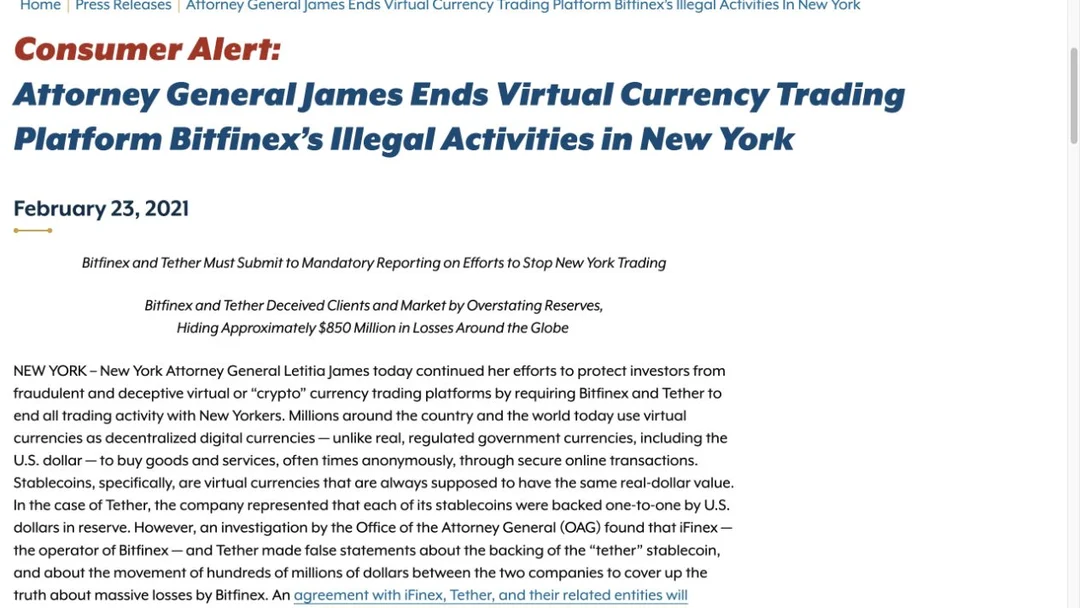
The historical document in the screenshot matters because reserve language has previously been contested. The New York Attorney General's February 2021 announcement describes misleading reserve representations and related-company funding arrangements in the investigated period. That finding cannot be erased by a later report. It also cannot be used as a measurement of today's reserve balance. Our NYAG case account keeps the historical questions separate.
Read the current token terms alongside the financial document. Account eligibility, verification and redemption conditions are relevant even when reported assets exceed liabilities. Neither a reserve report nor this article establishes that every holder has always redeemed at par. A holder who sells below the peg on an exchange can realise a loss even if direct issuer redemptions remain available to eligible clients.
Paxos: two monthly documents, and an examiner change
The distinction is unusually explicit on the PYUSD transparency page. Paxos publishes its own portfolio composition report before the independent attestation. The page says the self-reported document has not received independent review. Treating the two downloads as interchangeable would overstate the evidence.
That page also identifies KPMG LLP for attestation reports posted on or after February 28, 2025, and WithumSmith+Brown for earlier reports. A comparison table that still lists the older firm for 2026 reports is out of date. When an examiner changes, check the new report's scope and criteria too; swapping the name in a comparison table is only part of the update.
Regulatory labels require the same care. The OCC's December 12, 2025 announcement describes conditional approval of Paxos's conversion application. Paxos states that it completed conversion that day and has operated under OCC supervision since then. The current PYUSD page names Paxos Trust Company, N.A. The old description of its current status as only a New York limited-purpose trust was therefore incomplete.
Use token-specific material for USDP and PYUSD, and treat BUSD as a separate wind-down question. Paxos's BUSD page describes redemption to USD or conversion to USDP. It does not make every exchange account eligible for direct redemption. A delisting, a halt to new issuance and an issuer's redemption route are three different events; the BUSD timeline explains the distinction.
FDUSD: identify the issuer before interpreting its location
First Digital Labs' company page identifies its relationship with FD121 (BVI) Limited. Do not merge the brand, token issuer and Hong Kong custodian into one fictional legal entity. A custodian's trust-company status does not establish a stablecoin issuance licence for every associated business.
At the September 12, 2026 check, the transparency dashboard displayed July 31, 2026 figures: $350.156 million of tokens issued and in circulation, against $351.63 million in reserve accounts. Those are the issuer's dated displayed figures, not a live supply feed or our independent verification of bank balances. The previous article's $3–4 billion claim should not have been presented as current.
The same page describes a separate custodian and redemption through FD121 (BVI) Limited, subject to terms and suspension rights. It says direct customers must meet specified eligibility and AML/CTF requirements. For a retail holder, that leaves a practical question: which available venue will actually accept this token, on this network, and return the currency needed?
We do not assign FDUSD a future licence grade, claim that it has never faced stress, or publish an exchange-concentration percentage without a dated dataset. The FDUSD profile addresses the token's use case. Reserve documentation alone cannot establish order-book liquidity.
Why an accounting-firm logo is not a safety scale
Read the opinion before comparing the logos. Establish who prepared the assertion, who examined it, which criteria were used, what date or period was covered and what qualifications or limitations appear. The firm's reputation may influence your confidence, but a familiar name cannot expand an engagement beyond its stated scope.
A reserve attestation and a financial-statement audit answer different questions. Calling the first an audit of the entire business exaggerates its scope; dismissing it as meaningless discards the evidence it actually supplies. The useful description names the engagement and says what was examined. If you cannot find that in the document, leave the field unresolved.
Proof of on-chain assets has a related boundary. Public addresses can help track tokens and transactions. They do not by themselves establish every off-chain bank liability, lien, contractual claim or party entitled to an asset. A dashboard that combines blockchain data with a reserve report still relies on the off-chain evidence for the off-chain part.
The difficult part: from assets to your claim
Imagine that a report establishes adequate reserves, but your tokens sit inside an exchange account whose withdrawals are suspended. The issuer's assets and your ability to move the exchange balance are separate questions. Self-custody removes that particular account dependency while adding key-management responsibilities; it does not remove issuer or token-contract risks.
Now imagine that the report names a custodian. You still need to understand whose property is held, for whose benefit, and under which agreement. Segregation language is relevant evidence. It is not a reason to promise immediate repayment in every insolvency. Cross-border proceedings, disputed ownership and operational delays require more than a marketing-page interpretation.
A reserve review should therefore end with a route, not a grade: the supported token contract, the party accepting it, your eligibility, the currency returned, and the conditions that can stop the process. This is document review, not a request to send funds experimentally. If the route depends on opening an account you cannot qualify for, it is not your fallback.
Keep a record of what would change your conclusion
A useful review note is short enough to revisit. Save the report URL and date, the legal entity, the examiner's scope, the material asset categories and the relevant redemption terms. Record an unanswered question as unanswered. Filling a blank with last year's answer creates an appearance of continuity that the documents may not support.
Revisit the note when an issuer changes its terms, custodian, examiner or regulatory status, or when your own custody arrangement changes. A missed publication deserves investigation; it is not by itself proof of insolvency. Conversely, an uninterrupted series of reports does not guarantee access to funds during a later incident.
Holding several tickers can still leave the same bank, exchange or redemption bottleneck underneath. The USDC and USDT risk comparison considers those dependencies. More tickers are not automatically a safer portfolio, and this guide does not prescribe an allocation.
The decisive gap is often between what the document proves and what the holder needs it to prove. Keep that gap visible before making the next transfer.