
The reserve reports Tether publishes each quarter are a different kind of document, an attestation, in which an accounting firm reports on figures for a single day. BDO prepared the one for the second quarter of 2026, and its date is June 30. Because the two kinds of report answer different questions over different periods, the first thing to settle with any reserve report is which kind it is; the numbers come after.
A quarterly USDT reserve attestation checks assets and liabilities on one date
Tether's Q2 attestation announcement, dated July 31, 2026, says that the report was prepared by BDO, that it confirms the accuracy of Tether's Financial Figures and Reserves Report, and that it provides an overview of the assets backing USDT as of June 30, 2026. Three statements from the company's management follow, under the words "The Management of the Company asserts the following as of June 30, 2026":
- total assets of US$187,751,426,411;
- total liabilities of US$183,641,897,215, of which US$183,622,105,630 relate to digital tokens issued;
- assets exceeding liabilities by US$4,109,529,196.
All three describe June 30 and no other day, and the last figure is the first minus the second. Later movements in the price of reserve assets, and later issuance or redemption of tokens, are outside what the statements cover. A reserve attestation of this kind has management state figures for a point in time and an accounting firm give its conclusion on those figures.
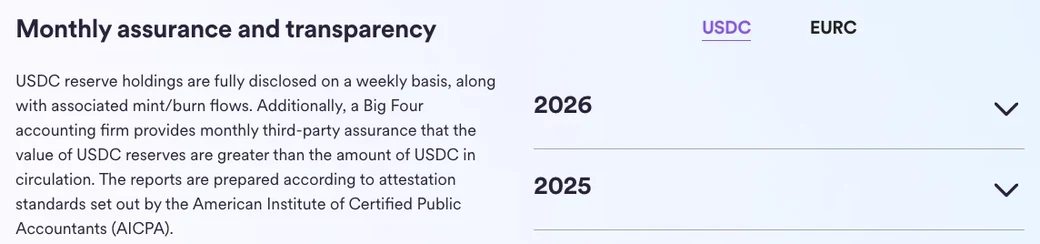
USDC's counterpart comes out monthly. On Circle's transparency page, USDC reserve holdings are disclosed on a weekly basis along with associated mint/burn flows, and a Big Four accounting firm provides monthly "third-party assurance that the value of USDC reserves are greater than the amount of USDC in circulation". Assurance in that sentence means the accounting firm's conclusion on the figures and carries no sense of a guarantee. The same page says the reports are prepared according to attestation standards set out by the American Institute of Certified Public Accountants (AICPA).
What did KPMG's audit of Tether's 2025 financial statements cover?
Tether announced on March 24, 2026 that it had entered a formal engagement with a Big Four accounting firm to complete its first full independent financial statement audit. Its audit announcement of August 13 describes work across the entirety of the financial statements: the full balance sheet, including the assets composing the reserves and the liabilities represented by the issued token, as well as the income statement, change of equity and cash flows statements, with each area subject to independent substantive testing and verification. For gold, KPMG is described as having physically counted and inspected every individual gold bar held by Tether, verifying the existence and identifying information of each bar rather than relying solely on reports from custodians or counterparties.
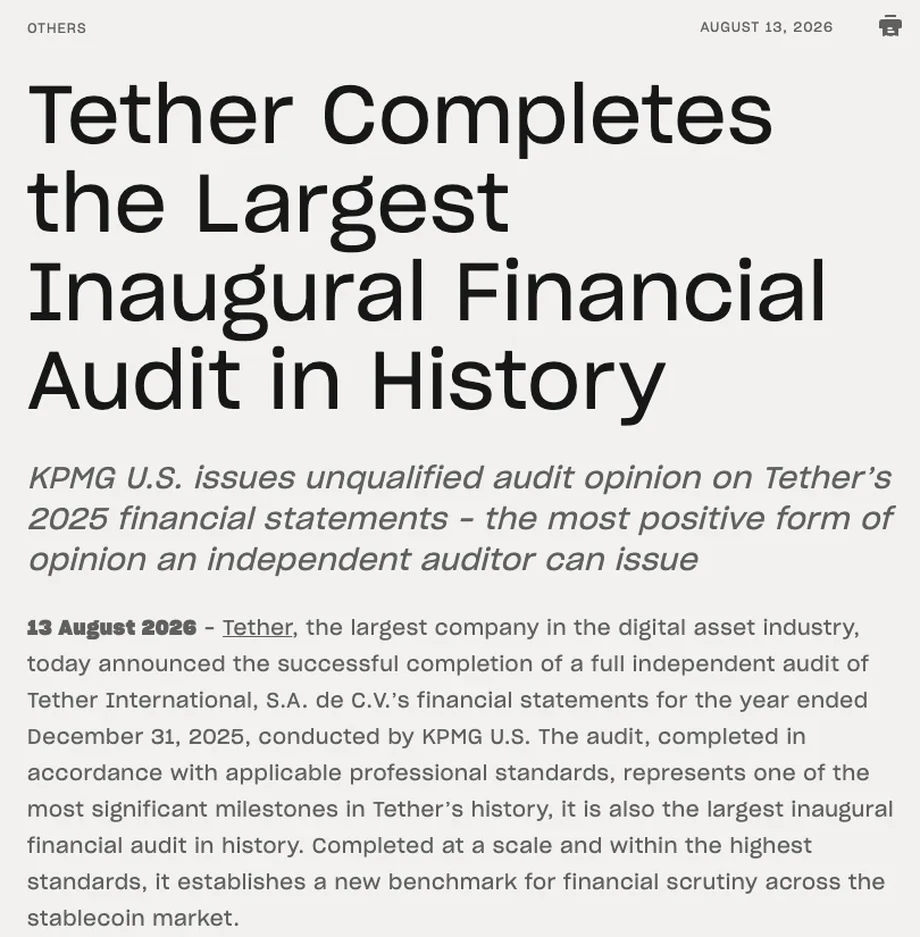
The question this audit answered, in the announcement's account, is whether the financial statements present fairly, in all material respects, the financial position of the company as of December 31, 2025, and the results of its operations and its cash flows for the year then ended, in accordance with U.S. generally accepted accounting principles (U.S. GAAP). The unqualified opinion Tether reports is KPMG answering yes. The audit's subject is a full set of statements for a year, where an attestation's is a handful of figures on one date.
Tether presents the audit as complementing its existing quarterly reserve reporting. The audited financial statements for the year ended December 31, 2025 report reserves exceeding the liabilities by $6.814 billion, a year-end figure taken from the chief financial officer's remarks quoted in the announcement. In the Q2 attestation announcement, management states that assets exceed liabilities by US$4,109,529,196 as of June 30, 2026. One number comes from an audit and the other from an attestation, on different dates, so a figure should never be read without its date.
How to tell whether a stablecoin reserve report is an attestation or an audit
Three details on an issuer's announcement and transparency pages settle it:
- The way the period is written. "As of" followed by a date gives the figures for that one day; "for the year ended" followed by a date gives a full year up to that day. Tether's Q2 announcement reads "as of June 30, 2026", and its audit announcement reads "for the year ended December 31, 2025".
- What the report calls itself and the standards behind it. Tether's Q2 announcement calls the report an attestation, and Circle's transparency page says its monthly reports are prepared according to the AICPA's attestation standards, so both belong with attestations. The words in Tether's audit announcement are audit and audit opinion.
- How often it is issued. Circle's reports are monthly and Tether's reserve reports quarterly, while Tether's audit corresponds to one full year.
| Basis of comparison | Reserve attestation report | Financial statement audit |
|---|---|---|
| Question answered | Whether the stated figures are accurate: for Tether's Q2 report, assets and liabilities on June 30; for Circle's monthly report, whether the value of USDC reserves is greater than the amount in circulation | Whether a year's financial statements present fairly in all material respects |
| Tether (USDT) | Quarterly attestation prepared by BDO; the report for Q2 of 2026 is as of June 30 | KPMG U.S. issued an unqualified opinion for the year ended December 31, 2025 (per Tether's announcement of August 13, 2026) |
| Circle (USDC) | Monthly third-party assurance from a Big Four accounting firm; reports prepared according to AICPA attestation standards | Deloitte & Touche LLP is Circle's independent auditor and has audited Circle's financials since fiscal 2022 |
Tether's transparency page dates its three asset and liability figures with the wording "as of the last Reserves Report (30 June 2026)"; in October 2026, the most recent reserve report the page refers to is the June 30 one. The three figures are Total Assets, Total Liabilities and Net Equity. Total Assets represents the assets owned by the Tether Issuer, which form the reserves backing Tether Tokens; Total Liabilities represents the Tether Issuer's liabilities; and Net Equity represents the excess of total assets over total liabilities.
Circle lists its reports on its transparency page by year and month, with one set for USDC and another for EURC, so checking a particular month means opening the report for that month.
GENIUS Act requirements for monthly reserve reports and an annual audit
The GENIUS Act, enacted in the United States on July 18, 2025, makes an accounting firm's examination of monthly reports and the audit of annual financial statements two separate obligations, each falling on a "permitted payment stablecoin issuer". The Act limits that term to a person formed in the United States that is one of three things: a subsidiary of an insured depository institution that has been approved to issue payment stablecoins, a Federal qualified payment stablecoin issuer, or a State qualified payment stablecoin issuer. Neither obligation applies before the Act takes effect, and section 20 sets that at the earlier of two dates: 18 months after the date of enactment, which is January 18, 2027, or 120 days after the primary Federal payment stablecoin regulators issue any final regulations implementing the Act.
A permitted payment stablecoin issuer has to publish the monthly composition of its reserves on its website, and each month it must have the information disclosed in the previous month-end report examined by a registered public accounting firm, a term that takes its meaning from section 2 of the Sarbanes-Oxley Act of 2002. The word in this provision is examined, where the annual provision uses audit. Each month the Chief Executive Officer and Chief Financial Officer must also submit a certification as to the accuracy of the monthly report to the issuer's regulator.
Among permitted payment stablecoin issuers, one with more than $50,000,000,000 in consolidated total outstanding issuance that is not subject to the reporting requirements under section 13(a) or 15(d) of the Securities Exchange Act of 1934 must prepare an annual financial statement in accordance with generally accepted accounting principles and have it audited by a registered public accounting firm. The audit is to be conducted in accordance with all applicable auditing standards established by the Public Company Accounting Oversight Board (PCAOB), and the audited statements are to be made publicly available on the issuer's website. Payment stablecoins not issued by a permitted payment stablecoin issuer face a separate limit in section 3, beginning on the date that is 3 years after the date of enactment: except as provided in subsection (c) and section 18, it becomes unlawful for a digital asset service provider to offer or sell such a stablecoin to a person in the United States. Whether a particular coin is affected depends first on whether its issuer is one of those three kinds of entity and, if it is not, on whether the exceptions in subsection (c) and section 18 apply. For USDT, a separate report on this site goes through the limits the Act puts on platforms selling it to people in the US.
At state level, the New York State Department of Financial Services issued guidance in June 2022 that applies only to stablecoins backed by the U.S. dollar and issued under DFS supervision by DFS-regulated virtual currency entities. Under it, the reserve must be subject to an examination of management's assertions at least once per month by an independent Certified Public Accountant licensed in the United States and applying the AICPA's attestation standards. The guidance's own heading for this requirement is Attestation.
Tether's audit and attestations apply only to the company and dates they name
Tether's transparency page defines its terms. "The Tether Issuer is Tether International, S.A. de C.V.", and when the term is used in connection with a particular reserve report it means the entity or entities identified in that report as issuing Tether Tokens. Corporate owned funds held by Tether Investments, S.A. de C.V. and other entities are not included in the reserves and are not part of Total Assets. The audit announcement names Tether International, S.A. de C.V. and the year ended December 31, 2025, which leaves 2026 figures outside the year the opinion covers.
Both kinds of report describe dates already past, and this holds for USDC as much as for USDT. Whether reserves are sufficient later on, and whether a holder can exchange tokens for US dollars at $1, depends on the assets at that time and on the issuer's redemption terms; a report's conclusion does not reach that far. A claim that USDT's reserves have been audited can be traced back to the report it refers to. The quarterly reserve reports are attestations, tied to figures management asserted for the last day of the quarter, and the audit opinion is tied to the 2025 financial statements.
Questions about Tether's audit and reserve reports
Which standards was Tether's audit carried out under?
The audit announcement mentions standards in two places. Its opening paragraph has the audit "completed in accordance with applicable professional standards", and the chief executive's quoted remarks refer to "AICPA standards". The financial statements that were audited are prepared under U.S. generally accepted accounting principles (U.S. GAAP).
Now that Tether's 2025 financial statements have been audited, do its quarterly reserve reports still matter?
Yes. Tether's announcement describes the audit as complementing its existing quarterly reserve reporting. The audited year ended on December 31, 2025, so reserve figures after that date are outside the audit opinion and appear in the quarterly reserve reports that follow; the one for the second quarter of 2026 is as of June 30.
What is Deloitte's role on Circle's transparency page?
Deloitte & Touche LLP is named there as Circle's independent auditor, which has audited Circle's financials since fiscal 2022. The sentence about USDC's monthly reports is a separate one: in it a Big Four accounting firm provides monthly third-party assurance, and the firm goes unnamed.