
For sending money and for use inside on-chain apps, the two tokens can stand in for each other in many cases, and Circle says so itself. They part ways when you cash out or deposit. To get US dollars back at 1:1, USDC.e has to be swapped to native USDC first. Binance doesn't book it under USDC either: USDC.e on Arbitrum carries the ticker ARBUSDCE on Binance, and USDC.e on Polygon carries MATICUSDCE.
Who issues USDC.e?
Circle's explainer on usdc.com, “What's the Difference Between USDC and USDC.e?”, says native USDC is issued by Circle's regulated entities. Its reserves are highly liquid cash and cash equivalents held at regulated financial institutions and attested every month by a Big Four accounting firm. USDC.e comes from someone other than Circle, usually a cross-chain bridge or a cross-chain trading platform. They lock native USDC in a smart contract on the chain it started on, then mint the same amount of the bridged version on the destination chain.
Holding USDC.e means trusting one more party: the bridge has to keep the locked USDC honestly and securely. Circle says this can introduce a new layer of counterparty risk. The comparison table on the same page sets the two side by side like this:
| Item | Native USDC | Bridged USDC (USDC.e belongs here) |
|---|---|---|
| Issuer | Circle's regulated entities | Third-party bridges or platforms |
| Redeemable 1:1 for US dollars | Yes, through Circle or on the secondary market | No, it has to be swapped back to USDC first |
| Security | Circle manages the reserves, which are attested monthly | Depends on the integrity and trustworthiness of the bridge |
| Availability | Natively supported on more than 20 blockchains (as of June 30, 2025) | Used on chains that don't have native USDC yet |
| Transparency | Public attestations and proof of reserves from a Big Four accounting firm | Limited, depends on the bridge provider |
How to tell USDC.e from native USDC by contract address
The name alone won't settle it. Wallets and exchanges usually label the native token plain USDC and the bridged one USDC.e or Bridged USDC. Some wallets still show the native token under its old name, USD Coin, and some bridged versions carry the bridge's name, such as Cronos Bridged USDC or Synapse Bridged USDC. There is no single naming convention.
To be sure, compare contract addresses. Find the contract address of the token in your wallet and check it character by character against the row for the same chain in Circle's developer documentation, “USDC contract addresses”. If they match, you hold native USDC. If they don't, Circle says it is likely USDC.e or another bridged version.
Arbitrum and Polygon each have a pair of addresses. The two USDC.e addresses come from Binance's two 2023 notices, and the two native addresses are the same strings in the Binance notices and in Circle's documentation:
| Chain | Token | Contract address |
|---|---|---|
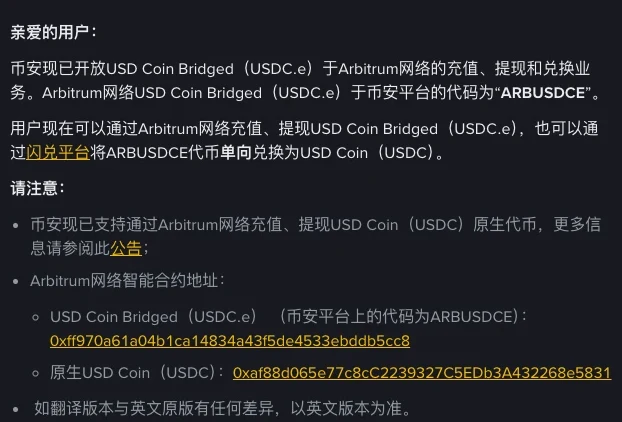
| Arbitrum | USDC.e | 0xff970a61a04b1ca14834a43f5de4533ebddb5cc8 |
| Arbitrum | Native USDC | 0xaf88d065e77c8cC2239327C5EDb3A432268e5831 |
| Polygon PoS | USDC.e (Binance's notice calls it the bridged USD Coin (PoS)) | 0x2791bca1f2de4661ed88a30c99a7a9449aa84174 |
| Polygon PoS | Native USDC | 0x3c499c542cEF5E3811e1192ce70d8cC03d5c3359 |
Check every character, not just the first and last few. If you still can't tell, ask the support team of the wallet, exchange or app you use, which is also what Circle's explainer recommends.
Other chains can be checked the same way. On Avalanche, users once bridged USDC from Ethereum through a third-party bridge and received USDC.e. Circle now issues native USDC on Avalanche, and the address in the Avalanche C-Chain row of its documentation is 0xB97EF9Ef8734C71904D8002F8b6Bc66Dd9c48a6E.
USDC.e on X Layer is not issued by Circle
Both tokens exist on X Layer. In Circle's contract address table, the X Layer row is the native USDC that Circle issues, at 0xB6CEceAB302E2E4948951eE7843FC24E92933061. The same page adds a note of its own for this chain: there is also a bridged version labelled USDC.e, which is not issued by Circle and not, in the page's own word, “backed” by Circle either. When you need Circle-issued USDC, use the address in the table.
Before you accept a payment on X Layer or deposit USDC into an app there, ask which contract the other side takes. Circle's documentation lists only the native address. The USDC.e address has to be checked in the official documentation of X Layer or of the bridge itself.
Depositing USDC.e to Binance: the tickers are ARBUSDCE and MATICUSDCE
Binance records the bridged and native versions as different assets. Its notice of November 9, 2023, “Binance Opens Deposits, Withdrawals and Conversions of USD Coin Bridged (USDC.e) on Arbitrum Network”, gives USDC.e on the Arbitrum network the ticker ARBUSDCE on the Binance platform. Users can deposit and withdraw it over the Arbitrum network, and can convert ARBUSDCE to USDC one way through Binance Convert. One way means the only direction offered is ARBUSDCE into USDC. The notice also states that Binance already supports deposits and withdrawals of native USDC on the Arbitrum network.
For Polygon, the reference is the notice of October 23, 2023 on native USD Coin (USDC) on the Polygon network. It said Binance would support the native USDC that Circle issues on Polygon, that the bridged USD Coin (PoS), which is USDC.e, would take the ticker MATICUSDCE, and that its deposits and withdrawals would stay supported. The notice also set a time: at 14:00 UTC+8 on October 25, 2023, Binance would suspend the existing USDC deposits and withdrawals on the Polygon network, with a separate announcement to follow once native USDC deposits and withdrawals opened. From start to finish the Polygon notice talked about deposits and withdrawals only. It said nothing about conversion through Convert.
On the deposit page this works out as follows. If your wallet holds USDC.e on Arbitrum, look for the asset under ARBUSDCE. Only native USDC is deposited as USDC. Polygon follows the same pattern, with USDC.e matched to MATICUSDCE. Both notices date from 2023. In October 2026 both tickers are still in Binance's coin list, with deposits and withdrawals open. The one-way conversion of ARBUSDCE to USDC rests on the November 2023 notice alone, so check the Convert page to see whether it is still offered. On a first transfer, send a small amount, and send the rest once it has arrived.
Can you redeem USDC.e with Circle for US dollars?
USDC.e can't go through Circle's redemption channel. It has to be swapped back to native USDC first. Circle's reserves stand behind the USDC that Circle issued. USDC.e is backed by the USDC a bridge has locked on another chain, and the bridge is also its issuer.
Individual holders are one more step removed. Minting and redeeming USDC directly with Circle goes through Circle Mint, an account that is currently open to institutions only, so individuals can't open one. A footnote on Circle's explainer spells it out: holders who are not Circle Mint customers buy USDC on the secondary market, and turn it back into fiat by selling on the secondary market as well, on an exchange for example. One more sentence follows: in line with the EU's MiCAR requirements, Circle will redeem all USDC presented to it for redemption, whether or not the holder is a Circle Mint customer.
Put together, an individual turning USDC.e into dollars has one step more than a holder of native USDC, and it comes at the front: swap to USDC, then sell on the secondary market.
Swapping USDC.e to native USDC: bridge, DEX or exchange
The routes Circle names are third-party bridges and decentralized exchanges (DEXs). Going back the way you came is one of them: in Circle's example, a bridged token that reached another chain through a bridge can be bridged back to Ethereum for the USDC that was locked at the start. Swapping USDC.e straight into USDC on a DEX is the other, at whatever price and fee the interface quotes when you place the trade.
Circle also warns about what can happen when bridged versions are transferred or swapped: extra steps, delays, or failed transactions, stuck tokens and limited functionality where apps, wallets and DEXs support bridged versions unevenly.
The exchange route comes from Binance's November 2023 notice: ARBUSDCE that has been deposited can be converted one way to USDC in Convert. That was the arrangement when the notice was published, so check that the option is still on the Convert page before you rely on it.
Not every USDC.e balance needs swapping. Whatever stays in use inside on-chain apps can be left alone. Only the part headed for an exchange deposit, or back to US dollars, needs the swap. Circle's view of bridged assets is that they are an important part of the blockchain ecosystem, particularly useful on chains native USDC hasn't reached yet, and that they open up multi-chain functionality before native assets arrive. Where native USDC is available on a chain, Circle considers the native version simpler and safer.
FAQ
Is USDC.e safe?
It carries one more dependency than native USDC: it is backed by USDC locked on another chain, so its safety comes down to the bridge involved. Circle's position is that bridges are one of the weak points in blockchain technology and that native USDC is safer than bridged versions. The same page also says bridged assets are an important part of the blockchain ecosystem, especially on chains that don't have native USDC yet.
Will USDC.e turn into native USDC automatically?
That depends on whether the bridged token on that chain was deployed under Circle's Bridged USDC Standard in the first place. For a contract deployed under the standard, Circle can, by agreement with the deployer, take over ownership of the contract and upgrade it in place to native USDC: the contract address stays the same and holders don't have to swap anything. Circle has the option to do this, not an obligation. The standard has to be adopted before deployment and can't be added afterwards.
Can CCTP turn USDC.e into native USDC?
CCTP transfers native USDC and doesn't handle USDC.e. It is Circle's Cross-Chain Transfer Protocol: native USDC is burned on the source chain and new native USDC is minted on the destination chain. Circle states specifically that bridges using CCTP move native USDC between chains. If what you hold is USDC.e, swap it to the native version through a third-party bridge or a DEX first.