Start with what the recipient will accept
A payment request that says USDT is incomplete. You need the network, token contract where relevant, recipient address and any deposit instructions. A wallet may display two assets with the same ticker while the receiving platform supports only one. The USDT and USDC guide explains the issuer distinction; here the immediate concern is delivering the asset the recipient can actually use.
Before choosing a bridge, check whether a transfer is needed at all. If the recipient accepts the token on the chain where you already hold it, an ordinary transfer avoids an additional bridge dependency. If the target is an exchange deposit, confirm that it accepts deposits from smart contracts or bridge routes. Some routes should first finish at a wallet you control, followed by a separate supported deposit.
The older version of this article supplied minute-by-minute transfer examples and fee totals without reproducible transaction evidence. Those examples have been withdrawn. A quote from your selected route is useful; a fabricated benchmark would make the decision less reliable.
Four ways value can reach the other chain
| Mechanism | What happens | What to examine |
|---|---|---|
| Issuer burn and mint | Tokens are burned on the source chain and issued on the destination after the required verification | Token, supported networks, attestation and finality requirements |
| Lock and wrap | An asset is held on one chain and a representation is issued elsewhere | Who controls backing, verification and the return path |
| Liquidity or intent route | A pool or participant supplies the output asset on the destination | Available liquidity, minimum output, fulfilment and refund conditions |
| Custodial deposit and withdrawal | A platform credits an account from one network and processes a withdrawal on another | Account eligibility, deposit support, holds and withdrawal availability |
An app can offer several mechanisms. The name on its home page is not enough to identify the route you are about to approve. A burn-and-mint design avoids a separate wrapped claim for that transfer, but still relies on contracts, message verification and issuer operations. A fast destination payment can also precede final settlement between other participants. Neither observation is a universal safety ranking.
CCTP: match the token and protocol version
Circle's CCTP documentation describes native USDC transfers through burn and mint, with Standard and Fast Transfer options. Source-chain confirmation, attestation and the destination transaction are distinct parts of the process. A front end may handle several of them for you; it does not eliminate their dependencies.
The supported-domain list needs to be read with its token table and version notes. At the September 2026 check, BNB Smart Chain appears as a domain, but USDC is explicitly excluded there; Sui and Noble appear under legacy V1. Thus both a blanket CCTP has no BNB support statement and a CCTP supports USDC on every listed domain statement would be misleading.
For an Ethereum-to-Base USDC transfer, inspect the actual contracts, destination asset, transfer mode, fee deduction and any separate destination execution requirement. Do not assume an old fee-free example applies to every version or transfer mode. Compare the output after all charges, and leave enough source-chain gas for any required approval and transfer.
When an attestation is pending, retain the source transaction and the service's transfer identifier. A successful burn is not a reason to submit a second burn. Follow the documented status and completion process for the same transfer.
Stargate and Allbridge: the selected route matters
Stargate V2's Bus and Taxi documentation explains its batching trade-off. Bus can share messaging costs across transfers; Taxi handles an individual transfer. Do not turn those modes into fixed minute counts. The route quote and the selected mode should agree before signing.
For a liquidity-based transfer, compare the amount supplied on the source with the minimum amount delivered on the destination. If the route swaps through another asset, that additional conversion belongs in the comparison. A displayed bridge fee alone may leave out source gas, price impact or destination execution. If the quote cannot meet the recipient's requirement, choose another route or stop.
Allbridge Core describes native stablecoin transfers across EVM and non-EVM chains and explicitly includes Tron USDT. The previous article's claim that USDT to Tron was exchange-only was wrong. A bridge can deliver liquidity already present on Tron without itself being Tether or minting Tether's tokens.
Allbridge Core and its other products are not interchangeable names. Its documentation describes messaging-agnostic routes and CCTP-powered USDC transfers; the selected route determines the relevant dependencies. Confirm the supported token pair and destination in the current interface. The existence of a Tron route does not guarantee an acceptable quote, uninterrupted availability or suitability for an exchange deposit.
Do not put every routing app under LayerZero
Jumper, Across and deBridge should not be filed together as LayerZero-routed aggregators; that label hides important differences. Across's documentation describes relayers supplying destination funds and later receiving repayment through its settlement process. The speed a recipient sees and the time needed for that repayment are different measurements.
deBridge describes DLN as an order-based system where solvers provide liquidity on demand rather than a shared liquidity pool for each transfer. Its documentation sets out fulfilment and cancellation processes. These are protocol-specific mechanisms, not evidence that every routing service is merely a wrapper around the same bridge.
When using a front end that compares routes, expand the proposed path. Record the bridge or execution provider, source and destination swaps, recipient and minimum output. A convenient interface can combine several steps that would otherwise be visible separately. If you cannot identify what the signature authorises, do not use the quoted saving as a reason to sign.
Using an exchange as an intermediate account
An exchange route can work when your existing, eligible account supports the exact incoming token/network and the outgoing token/network. It changes custody: during the middle of the process you hold an account balance, and the platform controls whether and when a withdrawal is processed. Its internal accounting does not require it to operate a public cross-chain liquidity pool.
- Open the receiving platform's current deposit instructions. Match the token, network, address and any required identifier. Check the minimum credited deposit.
- Check the outgoing network before depositing. Maintenance, account restrictions, withdrawal limits or a disabled network can prevent the second leg.
- Compare the source transaction fee with the withdrawal quote and any conversion cost. Avoid counting a fee twice if it is already deducted from the displayed amount received.
- After the deposit is credited, recheck the recipient and withdrawal quote. A previously displayed fee or availability status may have changed.
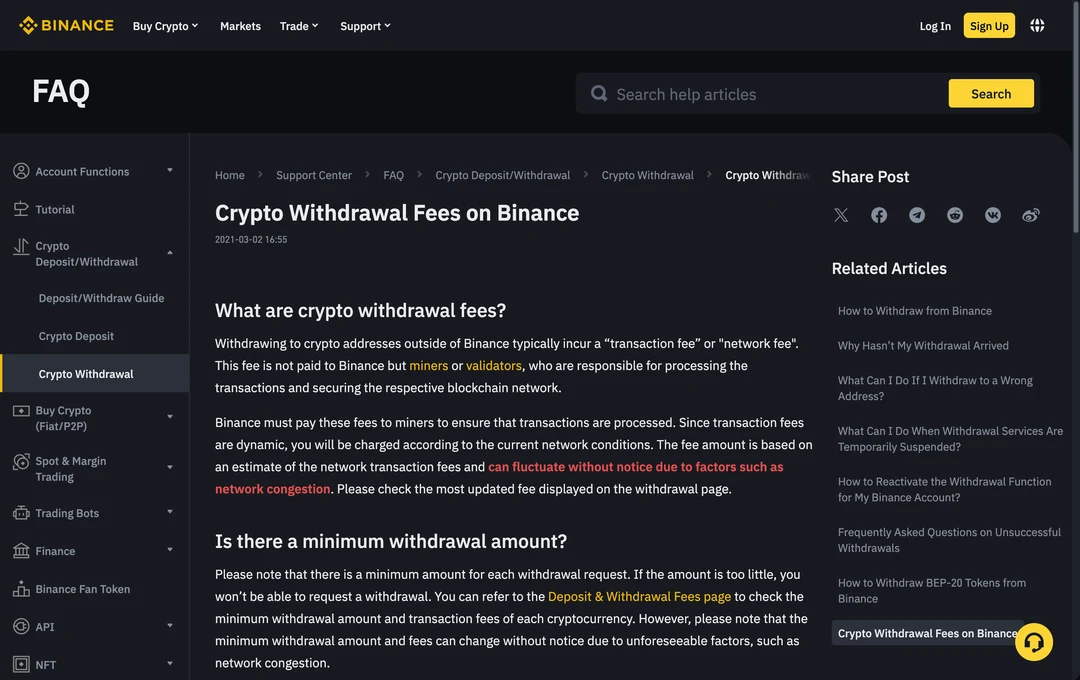
The help page shown above is a concrete reason not to rely on a fixed one-USDT fee or a fixed confirmation count. The same principle applies when another venue is the intermediary: inspect that venue's instructions rather than borrowing Binance's numbers.
A small transfer is not exempt from account checks. Nor does an existing account establish that a product is available in your current jurisdiction. This route is an option to evaluate, not the default cheapest or fastest answer for every reader. The cash-out guide covers the separate bank-payment leg.
Make the quotes comparable
Use the same source asset, destination asset, amount and recipient type. A quote that delivers a wrapped token to your wallet cannot be compared as though it delivers native USDC directly into an exchange balance. A quote that includes destination gas may also be buying something the cheaper-looking route leaves out.
For a same-token comparison, separate the amount lost between input and output from fees paid outside that amount. Add separately paid source gas and any extra conversion or destination cost, expressed in the same currency at a recorded price. If input and output are different stablecoins, do not silently assume both trade at exactly one dollar. The difference may include market price and conversion spread.
Time estimates need a definition too. A wallet confirmation, a destination fill, protocol settlement and exchange credit are different milestones. For a bill due today, the useful endpoint is when the recipient can use the funds. A seconds-fast source confirmation does not establish that endpoint.
Before signing, and if the transfer stalls
Check the exact spender and allowance requested by an approval. Limiting the allowance can reduce exposure, but does not make a malicious transaction safe. Review destination contract calls as well as the visible transfer amount. Save the quote and identifiers without recording seed phrases, private keys or account credentials.
A small test may expose an address or token mismatch. Choose an amount that satisfies the route's minimums and that you can afford to lose, then check the actual destination token. Success is useful evidence about that attempt; it is not insurance for a later, larger transfer or a different quote.
If the source transaction failed, distinguish that from a successful source transaction awaiting a later step. If it succeeded, use the official route tracker to identify whether confirmation, messaging, fulfilment, destination execution or account credit is pending. Follow the documented completion or refund procedure for that state. Do not pay a stranger to unlock the transfer or send another transfer merely because the first is slow.
For an actual destination mistake, use the wrong-chain recovery guide rather than this planned-transfer workflow. Recovery depends on control of the destination and the applicable process, not on how convincingly a support impersonator promises a result.
A transfer is complete when the intended recipient has the intended asset and can use it. Verify that outcome before closing the task.