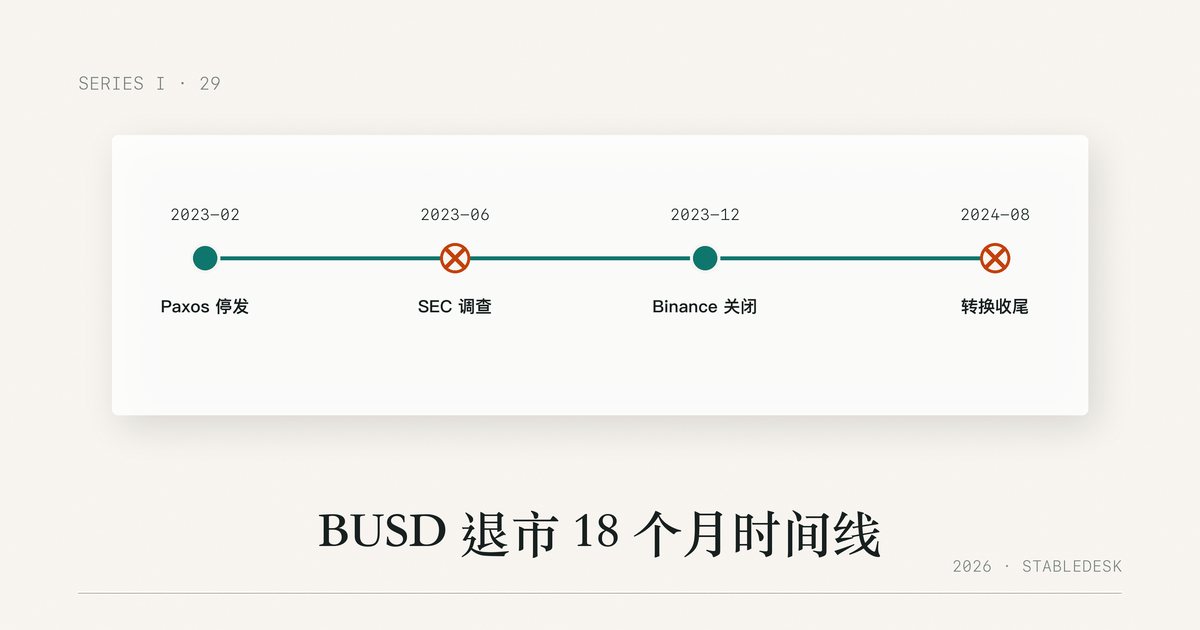
Where BUSD sat in the stablecoin market before 2023
By early 2023, BUSD was the third-largest US-dollar stablecoin by market capitalisation. CoinGecko's snapshot for January 31, 2023 listed BUSD at approximately 16 billion in circulation, behind USDT (around 67 billion) and USDC (around 41 billion). Most of that supply lived on Binance's exchange, in BUSD trading pairs, in BUSD-denominated savings products, and in the Binance Smart Chain ecosystem where BUSD was the dominant unit of account.
The token was issued by Paxos Trust Company under a New York limited-purpose trust charter. Paxos is the same company that issues USDP (its own branded stablecoin) and that issues PayPal's PYUSD. The "Binance USD" branding was a co-marketing arrangement: Binance promoted the token on its venue, Paxos retained the legal issuance and reserve-management responsibility. Reserves were attested monthly, held mostly in US Treasury bills and short-dated repos at the time of the NYDFS order.
February 2023 · the NYDFS letter
The combination — a state regulator halting new issuance, a federal agency signalling potential securities enforcement, and a partner-issuer publicly distancing itself — was sufficient to mark BUSD as a product without a future. Binance read the signal early.
March to June 2023 · the slow unwind on Binance
July to December 2023 · the migration runs
January to February 2024 · the Paxos redemption window
What holders actually did, in numbers
The migration pattern was visible in real time on chain. Etherscan and BscScan showed the BUSD circulating supply dropping in roughly weekly steps as Paxos processed batch redemptions and burned the corresponding tokens. The destination of redeemed funds was harder to track at the individual level but the aggregate destinations were clear from CoinGecko and DeFiLlama market-cap data over the same period.
| Period | BUSD supply (approx) | USDT supply change | USDC supply change | FDUSD supply |
|---|---|---|---|---|
| Jan 31, 2023 | 16.1B | 67B (baseline) | 41B (baseline) | n/a |
| May 31, 2023 | 5.4B | +16B | −12B | n/a |
| Sep 30, 2023 | 2.3B | +19B | −15B | 0.4B |
| Dec 31, 2023 | 0.9B | +27B | −17B | 2.6B |
| Feb 29, 2024 | 0.05B | +33B | −16B | 3.6B |
The picture is consistent. BUSD supply moved primarily into USDT and FDUSD, not into USDC. USDC continued to lose share over the same period for unrelated reasons (the SVB depeg in March 2023, the slow return of Coinbase retail flows, the broader rotation toward Tron USDT in payment use cases). The most direct beneficiaries of the BUSD wind-down, in order, were USDT, FDUSD and TUSD.
What the BUSD wind-down taught the desk
Lesson 1 · Issuer relationship risk is real and underpriced
BUSD was reserved 1:1 with US Treasury bills. The reserves were never the problem. The wind-down was driven by a regulator's view of the oversight relationship between Paxos and Binance — a structure that Paxos itself eventually framed as an issue. Holders who only tracked reserve composition missed the actual risk. The framework risk — the relationships between issuer, exchange and regulator — is what killed the product. We extended this analysis in stablecoin reserve transparency, where the reserve-quality picture is only one of three columns.
Lesson 2 · Regulators do not need a dramatic event to act
There was no BUSD depeg. There was no reserve shortfall. There was no public scandal. The NYDFS letter cited "unresolved issues" in the oversight relationship — a soft phrase that translated, in practice, to a hard cease-and-desist. For stablecoin holders, the lesson is that supervisory tools can be deployed on framework grounds in the absence of any market event. Reserve composition is necessary but not sufficient.
Lesson 3 · Migration paths are political, not technical
Binance chose FDUSD, not USDC or DAI, as the BUSD replacement. The choice was a business decision: FDUSD's issuer (First Digital Trust) was outside the US perimeter (Hong Kong), the operational integration with Binance was deeper, and FDUSD did not carry the same Paxos / NYDFS overhang that BUSD had developed. The technical migration was trivial; the political migration was the actual decision. Holders following the auto-conversion path landed in a token with a different regulatory backstop and a different reserve attestation regime, mostly without noticing.
What is left of BUSD in 2026
The smart contracts continue to exist on Ethereum and BNB Smart Chain. Paxos has frozen the mint function and stopped attestations. The on-chain supply, as reported by Etherscan as of mid-2026, is in the low tens of millions and decreasing slowly as residual tokens are bridged or burned. A small DEX market continues to trade BUSD against USDT at prices roughly 0.85 to 0.92, mostly driven by holders who missed the redemption window and are taking the realised loss to free up capital.
The brand is unlikely to return. Binance's working stablecoin on its exchange is FDUSD plus a growing emphasis on USDC after the April 2024 Circle partnership. Paxos focuses on USDP and on enterprise tokenisation work. The BUSD episode is now reference material rather than a live product.
If you want to act on this
The narrow action is to check residual balances on smaller exchanges and self-custody wallets. The broader action is to apply the BUSD lesson to current holdings: ask which issuer-exchange-regulator triangle you are exposed to, and whether a single non-reserve event (a regulator action against the partner exchange, for example) could produce a similar wind-down. The desk's working venue is Binance; the working stablecoins are USDT and a smaller USDC position; the working hedge is to keep some balance off-exchange. The Binance referral link uses code BN16188 and does not change your fees.
Tracing the BUSD timeline
- NYDFS Consumer Alert, "Re: Paxos Trust Company / Binance USD (BUSD)", February 13, 2023.
- Paxos press release, "Paxos Will Halt Minting New BUSD Tokens", February 13, 2023.
- Binance announcements, "Binance Will Cease Support for BUSD" series, June through December 2023, archived on the Binance announcements page.
- Paxos redemption notice, "BUSD Redemption Closing February 28, 2024", January 12, 2024.
- CoinGecko and DeFiLlama historical supply data for BUSD, USDT, USDC, FDUSD, TUSD, January 2023 through March 2024.
- SEC Wells notice reports — Bloomberg, Reuters, February 13-15, 2023.
If you spot an error in the timeline above, please write to [email protected] with the line — the corrections log is on the corrections page.